Meenyon’s Role in Improving Productivity in Distribution Centers
Distribution centers are under constant pressure to handle higher order volumes, faster turnaround times, and increasingly complex supply chain demands. As e-commerce continues to expand globally, the need for efficient warehouse operations has become a defining factor in business success. Productivity in these environments depends heavily on how effectively goods are moved, stored, and retrieved within limited timeframes.
In this context, equipment innovation plays a central role in reducing delays and improving workflow consistency. Companies like Meenyon have contributed to this shift by developing modern material handling solutions designed for efficiency and safety. Their focus on electric-powered systems helps distribution centers streamline daily operations while reducing physical strain on workers. One notable example is the use of electric lifting systems, where Meenyon equipment supports smoother pallet movement, especially in high-density storage environments where precision and reliability are essential.
Productivity Challenges in Modern Distribution Centers
Distribution centers face several operational challenges that directly impact productivity. One of the most significant issues is order volume variability. Sudden spikes in demand can overwhelm manual workflows, leading to delays and errors in fulfillment.
Another challenge is space utilization. Many facilities operate in constrained environments where maximizing vertical storage is just as important as horizontal expansion. Without efficient lifting equipment, accessing higher storage levels becomes time-consuming and labor-intensive.
Labor shortages and rising operational costs also add pressure. As experienced warehouse workers become harder to retain, businesses must rely more on equipment that reduces manual dependency while maintaining output consistency.
Technology-Driven Improvements in Material Handling
Advancements in warehouse equipment technology have transformed how distribution centers operate. Electric material handling systems, in particular, have replaced many traditional manual processes with faster and more controlled operations.
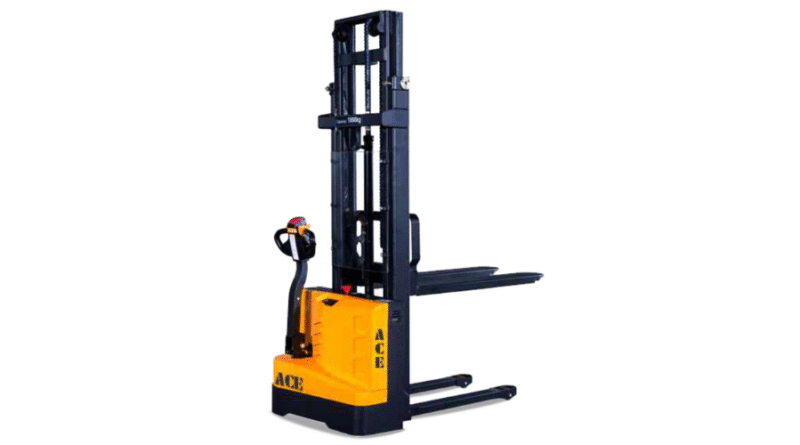
Electric stackers and similar devices use integrated motor systems and precision controls to handle loads with minimal effort. These machines improve workflow by allowing operators to move goods efficiently across narrow aisles and tight storage layouts.
Key technological improvements include:
- Energy-efficient electric drive systems for consistent performance
- Compact mechanical designs for better maneuverability
- Intelligent control interfaces for simplified operation
- Enhanced lifting stability for safer load handling
These innovations collectively reduce operational bottlenecks and increase throughput in busy distribution environments.
Operational Benefits of Modern Equipment
Modern warehouse equipment provides measurable benefits that directly impact productivity. One of the most important advantages is reduced handling time. Faster movement of goods across storage zones leads to quicker order processing and improved delivery performance.
Another major benefit is improved workplace safety. Automated lifting mechanisms reduce the risk of injuries associated with manual lifting, helping organizations maintain safer work environments.
Additional operational advantages include:
- Lower downtime due to reliable electric systems
- Reduced training requirements for operators
- Improved accuracy in pallet placement and retrieval
- Greater consistency in repetitive warehouse tasks
By improving both speed and safety, advanced equipment allows distribution centers to operate more efficiently under high-demand conditions.
Applications Across Distribution and Logistics Networks
Modern material handling systems are used across a wide range of distribution and logistics settings. In large-scale e-commerce fulfillment centers, they support rapid sorting and shipping of thousands of orders per day.
In retail distribution networks, these systems help manage stock replenishment and inventory distribution across multiple locations. Cold storage and pharmaceutical warehouses also rely on electric equipment due to its stable performance and low emissions, which are essential in controlled environments.
Transportation hubs and freight terminals benefit as well, where quick loading and unloading of goods is critical for maintaining schedule efficiency.
The Future of Productivity in Distribution Centers
The future of distribution center productivity is closely tied to automation, digitization, and energy efficiency. Equipment is becoming increasingly intelligent, with features such as predictive maintenance and real-time performance monitoring helping reduce unexpected downtime.
Sustainability is also becoming a key focus. Electric-powered systems are being adopted more widely as companies aim to reduce environmental impact while maintaining operational performance.
As these trends continue, manufacturers like Meenyon are expected to play a growing role in shaping the next generation of warehouse solutions. By combining efficient engineering with smart operational features, modern equipment will continue to redefine productivity standards in distribution centers worldwide.