How Pressure Die Casting Dies Influence Product Quality and Manufacturing Efficiency
Pressure die casting is widely used in modern metal manufacturing because it enables the production of complex components with consistent dimensions, detailed features, and relatively smooth surfaces. Industries such as automotive, electronics, telecommunications, and industrial machinery depend on this process to manufacture reliable metal parts in medium- and high-volume production. While casting machines and molten metal quality are important, the design and condition of the mold play an equally significant role in determining the final product’s performance.
A Pressure Die Casting Die is a precision-engineered metal mold used to shape molten metal under high pressure. It contains specially designed cavities, runners, gates, cooling channels, vents, and ejection mechanisms that control how metal enters, solidifies, and leaves the mold. A well-designed die helps improve dimensional accuracy, surface quality, production consistency, and cycle efficiency. Understanding how these tools influence manufacturing performance can help businesses make better decisions when developing die-cast components.
What Is a Pressure Die Casting Die?
A pressure die casting die is a reusable steel mold designed to produce metal components through a high-pressure casting process. Molten metal is injected into the die cavity at high speed, filling the required geometry before solidifying.
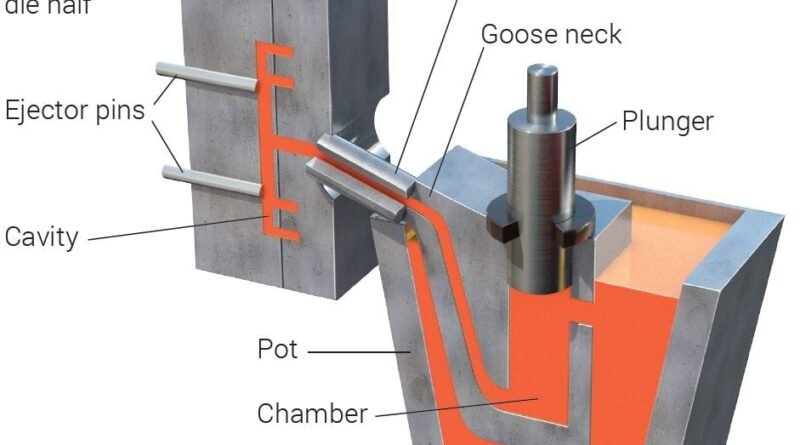
The die usually consists of two main sections:
- Fixed die half: Attached to the stationary side of the casting machine and generally contains the metal injection system.
- Moving die half: Attached to the movable side and opens to release the finished casting.
Together, these sections create the cavity that determines the shape and dimensions of the component. The die also incorporates additional features that support metal flow, temperature control, venting, and part removal.
Pressure die casting dies are commonly used with non-ferrous alloys such as aluminum, zinc, and magnesium. Their design must account for the properties of the selected metal, component geometry, production volume, and required quality standards.
Main Components of a Pressure Die Casting Die
Every part of a die contributes to the casting process. Proper coordination between these elements helps maintain production stability and product quality.
1. Die Cavity
The cavity defines the external shape and many of the dimensions of the finished component.
Its design must account for metal shrinkage, draft angles, wall thickness, and other manufacturing considerations. Accurate cavity machining is essential for producing components that meet specified dimensional requirements.
2. Core and Core Inserts
Cores create internal features such as holes, channels, recesses, and openings.
Some cores are fixed, while others are designed to move through mechanisms such as slides or hydraulic systems. Proper core alignment is important for maintaining dimensional accuracy and preventing unwanted flash.
3. Runner System
The runner system guides molten metal from the injection point toward the mold cavity.
Its geometry influences metal flow, filling speed, and pressure distribution. A properly designed runner helps ensure that molten metal reaches the required sections efficiently.
4. Gates
Gates are the openings through which molten metal enters the cavity.
Their position, size, and shape influence filling behavior and the quality of the finished casting. Incorrect gate design may contribute to turbulence, incomplete filling, or surface defects.
5. Venting System
Vents allow air and gases inside the cavity to escape as molten metal enters.
Effective venting helps reduce gas entrapment and certain porosity-related problems. Vent dimensions and locations must be carefully designed to release air without allowing excessive metal leakage.
6. Cooling Channels
Cooling channels regulate die temperature during production.
Their arrangement influences solidification time, thermal balance, and dimensional stability. Proper temperature control can also help reduce cycle time and limit thermal stress on the die.
7. Ejector System
The ejector system releases the solidified casting when the die opens.
Ejector pins and related mechanisms must be positioned carefully to remove the part without causing deformation, surface marks, or damage.
How Die Design Influences Product Quality
The quality of a die-cast component depends heavily on the geometry and performance of the die. Even small design weaknesses can create repeated defects across production batches.
1. Improves Dimensional Accuracy
The die cavity establishes the shape and dimensions of the finished component.
Precision machining, suitable tooling materials, and careful control of thermal expansion help maintain dimensional consistency. Proper die alignment also reduces the risk of mismatch between the two mold halves.
2. Supports Better Surface Finish
The condition of the die cavity directly influences the surface appearance of the casting.
Smooth cavity surfaces, appropriate coatings, and regular maintenance can help reduce surface irregularities. Gate placement and metal flow design also influence visible flow marks and other surface imperfections.
3. Reduces Casting Defects
A well-engineered die helps control the movement of molten metal and the removal of trapped air.
Suitable runner, gate, and vent designs can reduce the likelihood of incomplete filling, cold shuts, and gas-related defects. Cooling and feeding considerations are also important for controlling shrinkage-related problems.
4. Maintains Consistent Wall Thickness
Uniform wall thickness supports predictable metal flow and cooling.
The die must reflect a component design that avoids unnecessary variations in section thickness. Properly designed transitions and ribs can improve manufacturability and reduce the risk of localized shrinkage or distortion.
5. Improves Component Repeatability
Automotive and industrial manufacturers often require large quantities of components with similar dimensions and performance.
A stable die design helps produce repeatable results across multiple casting cycles. However, consistent output also depends on machine settings, alloy quality, temperature management, and tooling maintenance.
How Pressure Die Casting Dies Improve Manufacturing Efficiency
Beyond product quality, die performance has a direct effect on production speed, operating costs, and equipment utilization.
1. Shorter Production Cycles
Efficient cooling channel design helps remove heat from the casting and die at a controlled rate.
When cooling is properly balanced, components can solidify within an appropriate cycle time. This can improve machine productivity without compromising casting quality.
2. Reduced Material Waste
A well-designed runner and gating system helps deliver molten metal to the cavity efficiently.
Optimized metal flow can reduce unnecessary excess material and limit defects that would otherwise require components to be rejected. The actual material savings depend on component geometry and the overall casting design.
3. Lower Rework Requirements
Accurate tooling and stable process conditions reduce the likelihood of dimensional errors and surface defects.
When components consistently meet specifications, manufacturers may spend less time on corrective machining, finishing, and inspection-related rework.
4. Longer Tooling Service Life
The die is exposed to repeated thermal cycles, mechanical pressure, and contact with molten metal.
Selecting suitable hot-work tool steel, applying appropriate heat treatment, and using effective cooling arrangements can improve durability. Regular inspection and maintenance help identify wear before it causes major production problems.
5. Better Production Consistency
A properly engineered die supports stable filling, cooling, and ejection conditions.
This makes it easier for manufacturers to maintain repeatable production settings and plan output more effectively.
6. Improved Equipment Utilization
Tooling failures and repeated adjustments can interrupt manufacturing schedules.
A reliable die reduces unnecessary downtime and supports more predictable machine operation. This helps manufacturers make better use of equipment and production capacity.
Common Materials Used for Pressure Die Casting Dies
Die materials must withstand high temperatures, repeated pressure, thermal cycling, and mechanical wear.
Hot-Work Tool Steel
Hot-work tool steels are commonly used because they offer useful resistance to thermal fatigue, heat, and mechanical stress.
Their performance depends on the specific grade, heat treatment, operating temperature, and maintenance practices.
H13 Tool Steel
H13 is a widely used hot-work tool steel for pressure die casting applications.
It offers a combination of hot hardness, toughness, and resistance to thermal cracking. It is commonly selected for die components exposed to demanding operating conditions.
Other Tool Steel Grades
Other hot-work tool steels may be selected depending on the die design, casting alloy, operating conditions, and expected production volume.
The appropriate material should be chosen according to tooling performance requirements rather than cost alone.
Factors to Consider When Designing a Pressure Die Casting Die
Effective die design requires coordination between product engineering, tooling specialists, and casting process engineers.
1. Component Geometry
The shape and complexity of the component influence cavity design, core placement, and ejection arrangements.
Designers should consider draft angles, wall thickness, ribs, openings, and transitions to support reliable mold filling and part removal.
2. Alloy Selection
Different casting alloys have different melting temperatures, fluidity, shrinkage behavior, and interactions with die materials.
The selected alloy influences gate design, cooling requirements, die material selection, and expected tooling life.
3. Metal Flow Characteristics
Molten metal should enter the cavity in a controlled manner.
The runner and gate system must be designed to minimize unnecessary turbulence and promote complete filling. Flow simulation can help identify potential problems before tooling is manufactured.
4. Thermal Management
Temperature distribution affects solidification, casting quality, and die durability.
Cooling channels should be positioned to manage heat effectively while avoiding excessive temperature differences across the die.
5. Ejection Requirements
The component must be released without damage or distortion.
Ejector pins should be positioned according to the component’s geometry and solidification behavior. Complex parts may require slides, lifters, or other specialized mechanisms.
6. Production Volume
Expected production quantity influences the required tooling design, material selection, and maintenance strategy.
High-volume production may justify more sophisticated tooling features that improve cycle time and service life.
Common Problems Associated With Poor Die Design
Poor tooling design can lead to repeated manufacturing defects, higher operating costs, and unnecessary production interruptions.
Porosity
Porosity consists of small voids inside the casting. It can result from trapped gas or shrinkage during solidification.
Improved venting, optimized gate placement, controlled injection conditions, and appropriate thermal management can help reduce porosity.
Flash Formation
Flash occurs when molten metal escapes through gaps between die sections or around moving components.
It may result from inadequate die clamping, worn tooling, poor alignment, or excessive injection pressure. Regular die inspection and proper machine setup help control this problem.
Cold Shuts
Cold shuts develop when separate streams of molten metal meet but do not fuse properly.
Suitable metal temperatures, gate placement, and filling conditions help reduce the risk.
Die Soldering
Die soldering occurs when molten metal adheres to the die surface.
It can damage cavity surfaces and make casting removal difficult. Appropriate die materials, coatings, temperature control, and release agents help minimize this issue.
Thermal Fatigue
Repeated heating and cooling can cause cracks to develop on die surfaces.
Proper material selection, heat treatment, cooling design, and maintenance help improve resistance to thermal fatigue.
Dimensional Variation
Changes in die temperature, wear, alignment, or cooling behavior can affect component dimensions.
Routine measurement and preventive maintenance help maintain tooling accuracy.
The Importance of Die Maintenance
Even a well-designed die requires regular maintenance to preserve its performance.
A structured maintenance program should include:
- Routine cleaning: Remove metal residues, deposits, and other contaminants from cavity surfaces and vents.
- Surface inspection: Check for cracks, erosion, soldering, and signs of thermal fatigue.
- Cooling system checks: Ensure that cooling channels remain clear and operate effectively.
- Ejector system inspection: Check ejector pins, guides, and related mechanisms for wear or misalignment.
- Dimensional verification: Measure critical tooling features to identify changes caused by wear.
- Preventive repairs: Address minor damage before it affects production quality or causes extended downtime.
Consistent maintenance can extend die service life and support more predictable manufacturing performance.
Applications of Pressure Die Casting Dies in Different Industries
Pressure die casting dies are used to manufacture components for a wide range of industrial applications.
Automotive Manufacturing
Automotive manufacturers use pressure die casting dies to produce engine housings, transmission cases, brackets, motor enclosures, and selected structural components.
The process supports repeatable production of complex metal parts with relatively low weight and consistent dimensions.
Electrical and Electronics
Electrical products often require protective housings and components with integrated mounting features.
Die casting can produce enclosures, heat sinks, connectors, and other parts where thermal performance and dimensional accuracy are important.
Telecommunications
Telecommunications equipment requires durable housings that protect sensitive internal electronics.
Pressure die casting supports the manufacture of compact enclosures with detailed geometries and suitable thermal characteristics.
Industrial Machinery
Machinery manufacturers use die-cast components for covers, supports, housings, and selected mechanical assemblies.
The process can help simplify component geometry and support efficient production.
How to Choose a Reliable Pressure Die Casting Manufacturer
Selecting a capable manufacturing partner is essential for achieving reliable tooling performance and consistent casting quality.
Consider the following factors when evaluating a supplier:
- Tooling design expertise: Look for experience in die engineering, cavity design, and mold flow analysis.
- Material knowledge: Confirm that the manufacturer understands suitable die materials and casting alloys.
- Manufacturing facilities: Review available machining equipment, heat treatment capabilities, and tooling production resources.
- Quality control: Ask about dimensional inspection, casting evaluation, and documented process controls.
- Maintenance support: Check whether the supplier can provide tooling repairs, modifications, and preventive maintenance.
- Production experience: Evaluate experience with similar component designs and production volumes.
- Technical communication: A reliable partner should be able to discuss design improvements and manufacturing limitations clearly.
Working with an experienced supplier can help reduce development risks and improve the long-term performance of both the tooling and finished components.
Conclusion
Pressure die casting dies have a major influence on product quality and manufacturing efficiency. Their design determines how molten metal enters the cavity, how air escapes, how the component cools, and how the finished part is released. These factors directly affect dimensional accuracy, surface finish, defect prevention, and production consistency.
A well-designed and properly maintained die can also reduce cycle times, material waste, rework, and unexpected downtime. By focusing on tooling materials, cavity geometry, metal flow, thermal management, and preventive maintenance, manufacturers can improve production performance and deliver dependable die-cast components for automotive, electronics, and industrial applications.