
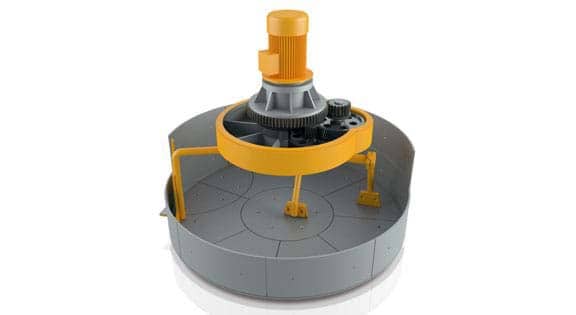
Concrete Planetary Mixer: How to Choose the Right Mixer for Your Project
Choosing the right concrete mixer can have a direct impact on production efficiency, batch consistency, and finished-product quality. Different concrete applications require different mixing intensities, capacities, and operating conditions. Understanding the available mixer options is therefore an important step before investing in new equipment.
A Concrete Planetary Mixer uses multiple mixing tools that rotate around their own axes while also moving around the central axis of the mixing pan. This planetary movement creates extensive material circulation and can provide thorough mixing for concrete formulations used in precast, paving, block, and other applications.
What Is a Concrete Planetary Mixer?
A concrete planetary mixer is an industrial mixer designed to combine cement, aggregates, water, admixtures, and other components into a homogeneous concrete mixture.
Unlike a basic single-shaft mixer, the mixing tools follow planetary paths. This allows the tools to cover different areas of the mixing pan and repeatedly move material through the active mixing zone.
The design can be particularly useful when consistent and intensive mixing is required.
How Does a Planetary Mixer Work?
The mixing process starts with the controlled loading of concrete ingredients into the mixing pan. Once the mixing cycle begins, the tools rotate individually while traveling around the center of the pan.
This combined movement creates multiple material-flow patterns. Concrete is pushed, lifted, folded, and redistributed as it moves through the mixing chamber.
Scrapers may also help move material away from the walls and back toward the mixing tools.
Why Mixer Selection Matters
Concrete formulations can vary significantly between projects. A mixer that performs well for one application may not be the best choice for another.
Factors such as aggregate size, moisture content, concrete consistency, production volume, and required mixing time all affect equipment requirements.
Selecting a mixer based on the complete production process can help avoid capacity problems and inconsistent mixing.
Determine Your Required Capacity
Capacity is one of the first specifications to evaluate. Start by calculating the amount of concrete required per batch and the desired hourly production rate.
Do not focus only on the nominal volume of the mixing pan. Loading time, mixing time, discharge time, and cleaning requirements can all affect actual production output.
If production is expected to increase in the future, this should also be considered during equipment selection.
Consider the Concrete Formulation
Different concrete mixtures can behave differently during mixing. High aggregate content, low-slump formulations, mineral additives, fibers, or other specialized ingredients may require more intensive mixing.
Before selecting equipment, identify:
- Aggregate type and size
- Cement content
- Water content
- Admixtures
- Moisture levels
- Target slump or consistency
- Special additives
This information helps determine whether a particular mixer configuration is appropriate.
Evaluate Mixing Uniformity
Uniformity should be a major consideration when comparing mixers. Cement paste, aggregates, water, and additives need to be distributed consistently throughout the batch.
A planetary mixer should provide effective circulation across the mixing pan and minimize areas where material remains inactive.
For specialized concrete formulations, testing actual materials can help confirm the required mixing cycle and equipment configuration.
Check Mixing Tool Configuration
The number, shape, and arrangement of mixing tools can influence the way material moves through the pan.
Different applications may require different tool configurations. Wear-resistant tools can also be important when processing abrasive aggregates.
Ask about tool service life, replacement procedures, and availability of spare components before purchasing.
Consider Mixing Cycle Time
Mixing time affects both quality and production efficiency. A cycle that is too short may result in insufficient material distribution, while an unnecessarily long cycle can increase energy consumption and reduce output.
The appropriate cycle should be established according to the actual formulation and required degree of homogeneity.
Manufacturers should provide realistic performance information rather than relying only on theoretical specifications.
Evaluate the Discharge System
Efficient discharge is important for maintaining a productive mixing cycle. Concrete should leave the pan effectively without excessive material remaining inside.
The discharge design should also suit the downstream equipment, whether the concrete is going to a mold, conveyor, hopper, or other production stage.
Reducing material retention can help improve throughput and simplify cleaning.
Consider Automation
For automated concrete production, the mixer should integrate with the batching and control system.
Automation can manage parameters such as:
- Ingredient dosing
- Mixing speed
- Mixing time
- Water addition
- Admixture dosing
- Discharge sequence
Automated control can improve repeatability and reduce variation caused by manual operation.
Examine Construction and Wear Resistance
Concrete aggregates can be abrasive, especially during continuous production. Mixer components should therefore be designed to withstand the expected operating conditions.
Pay particular attention to the mixing tools, pan liners, scrapers, shafts, bearings, and seals.
Durable components can reduce maintenance frequency and help maintain consistent mixer performance.
Assess Maintenance Requirements
Before purchasing a mixer, determine how routine maintenance will be performed. Components that are difficult to access may increase service time and production downtime.
Ask about inspection intervals, lubrication requirements, wear-part replacement, and spare-parts availability.
A clear preventive maintenance schedule can help protect equipment performance over its service life.
Consider Energy Consumption
Planetary mixers use mechanical energy to generate intensive mixing action. Energy efficiency should therefore be evaluated together with cycle time and production output.
The objective is not simply to minimize power consumption but to achieve the required mixing quality with an efficient operating cycle.
Comparing energy use per batch or per unit of concrete can provide a more meaningful assessment.
Review Equipment Integration
The mixer should fit properly into the overall production layout. Consider its connection with aggregate storage, weighing systems, cement feeding, water dosing, admixture systems, conveyors, and molding equipment.
Installation space, electrical requirements, discharge height, and control interfaces should all be reviewed before purchase.
Good integration can help prevent material-flow bottlenecks.
Compare Total Cost of Ownership
The purchase price is only one part of the investment. Long-term costs may include electricity, maintenance, replacement parts, installation, labor, and downtime.
A mixer with a higher initial cost may provide better value if it offers greater durability and more reliable production.
Comparing total ownership costs can help identify the most practical option for the project.
Questions to Ask Before Buying
Before making a final decision, ask the supplier:
- What capacity is recommended for the required production rate?
- Can the mixer handle the intended concrete formulation?
- What mixing cycle is expected for the application?
- Which components are most exposed to wear?
- How frequently do mixing tools and liners require replacement?
- What automation options are available?
- How efficiently does the mixer discharge?
- What spare parts and technical support are provided?
Clear answers can help reduce uncertainty during equipment selection.
Conclusion
Choosing the right concrete planetary mixer requires more than comparing mixer capacity or purchase price. The concrete formulation, production volume, mixing uniformity, cycle time, tool configuration, automation, maintenance, and equipment integration should all be evaluated.
A mixer selected according to the specific requirements of the project can support consistent concrete quality and efficient production. Careful comparison of technical specifications and long-term operating costs can also help manufacturers make a more informed investment.