How to Choose a Reliable Solid Surface Manufacturer for Your Construction Project
Selecting the right materials is an important part of planning a successful construction project. Countertops, bathroom vanities, reception desks, washbasins, and decorative surfaces must meet specific requirements for appearance, functionality, durability, and maintenance. Solid surface materials have become a popular option for these applications because they offer design flexibility, smooth finishes, and opportunities for customized fabrication.
However, the quality of the finished product depends heavily on the manufacturer’s materials, production methods, technical knowledge, and quality control procedures. Choosing a reliable Solid Surface Manufacturer can help contractors, architects, developers, and distributors obtain products that meet their project specifications. Before placing an order, buyers should evaluate several important factors to reduce sourcing risks and achieve better long-term value.
1. Understand Your Project Requirements
Before contacting manufacturers, clearly define the requirements of your construction project. Different applications may require different material properties, dimensions, finishes, and fabrication methods.
For example, a residential kitchen countertop may have different requirements from a hotel bathroom vanity or a commercial reception desk.
Start by identifying:
- Intended product applications
- Required material thickness
- Preferred colors and patterns
- Surface finish
- Product dimensions
- Customized shapes and edge profiles
- Expected order quantities
- Installation conditions
- Project budget
- Required delivery schedule
Having these details ready makes it easier to compare manufacturers and obtain accurate quotations.
2. Examine the Manufacturer’s Industry Experience
Experience can provide useful insight into a manufacturer’s ability to manage different product requirements and construction projects.
A company with established experience may have developed practical knowledge of material selection, fabrication, finishing, packaging, and quality management.
When reviewing a manufacturer’s background, consider:
- Years of experience in solid surface production
- Range of manufactured products
- Experience with residential and commercial projects
- International export experience
- Knowledge of customized fabrication
- Examples of completed projects
- Ability to handle large orders
Ask for product catalogs, project photographs, and relevant references where available.
However, experience alone does not guarantee quality. It should be considered alongside current production capabilities, technical documentation, and product inspection results.
3. Review the Manufacturer’s Product Range
A suitable manufacturer should offer products that match your construction requirements.
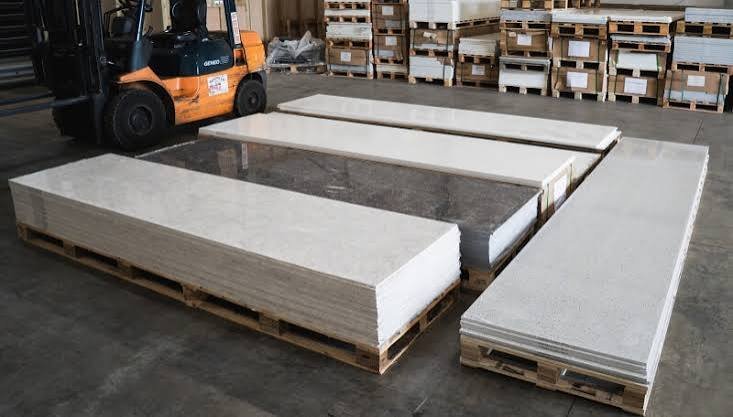
Solid surface materials can be supplied as sheets or fabricated into finished components. Some manufacturers also provide customized products for specific interior applications.
Common product categories include:
- Solid surface sheets
- Kitchen countertops
- Bathroom vanity tops
- Integrated washbasins
- Reception counters
- Commercial washroom surfaces
- Decorative wall panels
- Customized interior fixtures
A broader product range may simplify sourcing when a project requires several coordinated components.
Buyers should also check whether the manufacturer can provide matching colors and finishes across different product categories.
4. Evaluate Raw Material Quality
The composition of solid surface materials has a direct influence on their appearance, processing characteristics, and physical performance.
Many solid surface products are manufactured using a combination of resin, mineral fillers, pigments, and other additives. Different formulations can produce different characteristics.
Common considerations include:
- Resin type and formulation
- Mineral filler composition
- Pigment distribution
- Material uniformity
- Surface quality
- Product thickness
- Relevant performance test results
Ask manufacturers for technical specifications and information about the materials used in production.
Do not assume that products with similar appearances have identical compositions or performance. Reviewing samples and supporting documentation is important when comparing suppliers.
5. Check Manufacturing Technology and Equipment
Modern manufacturing equipment can help improve production accuracy, consistency, and efficiency.
Manufacturers may use different technologies for mixing, molding, curing, cutting, shaping, sanding, and polishing.
Relevant equipment and processes may include:
- Controlled material mixing systems
- Sheet molding equipment
- Curing systems
- CNC cutting machines
- Precision fabrication tools
- Automated polishing equipment
- Dust extraction systems
The importance of each technology depends on the products being manufactured.
For example, a construction project involving curved reception desks and customized integrated sinks may require more advanced fabrication capabilities than a project ordering standard sheets.
Ask whether the manufacturer has the equipment and trained personnel needed to complete your specific designs.
6. Assess Quality Control Procedures
Quality control is one of the most important factors when choosing a solid surface supplier. Inconsistent production can lead to color variations, surface defects, dimensional problems, and fabrication difficulties.
A reliable manufacturer should have inspection procedures covering different stages of production.
These may include:
- Raw material inspection.
- Formulation and production monitoring.
- Sheet thickness measurement.
- Color consistency checks.
- Surface appearance inspection.
- Dimensional verification.
- Finished product evaluation.
- Packaging inspection.
For larger construction projects, buyers may arrange independent inspections before shipment.
It is also useful to ask how the manufacturer handles defective products and whether corrective actions are documented.
7. Request Physical Samples Before Ordering
Physical samples allow buyers to examine material characteristics more accurately than photographs or online catalogs.
Samples should be reviewed under lighting conditions similar to those expected in the finished project.
Pay attention to:
- Color accuracy
- Pattern consistency
- Surface smoothness
- Thickness
- Edge appearance
- Material uniformity
- Finish quality
If the project requires multiple colors or finishes, request samples of each option.
Once a sample is approved, keep it as a reference for future production batches. This can help reduce misunderstandings about the expected product appearance.
For customized countertops and sinks, finished samples or examples of previous fabricated components may provide additional insight into the manufacturer’s workmanship.
8. Compare Customization Capabilities
Construction projects frequently involve unique layouts and architectural designs. Standard product dimensions may not fit every requirement.
A manufacturer with suitable customization capabilities can help produce components according to project drawings and specifications.
Customization options may include:
- Special sheet dimensions
- Customized colors
- Curved countertops
- Integrated sinks
- Decorative edge profiles
- Special basin configurations
- Customized reception desks
- Project-specific fabrication
Before selecting a supplier, confirm whether customization is completed in-house or outsourced to another facility.
Also discuss sample approval, minimum order quantities, design revisions, and additional production costs.
9. Evaluate Technical Support and Communication
A manufacturer’s ability to provide technical support can be especially valuable when dealing with complex construction projects.
Buyers may need assistance with material selection, product dimensions, fabrication requirements, installation details, or maintenance procedures.
A dependable supplier should communicate clearly and provide useful information when questions arise.
Evaluate the manufacturer’s ability to:
- Review technical drawings
- Explain material specifications
- Recommend suitable product options
- Clarify fabrication limitations
- Provide installation guidance
- Respond to technical questions
- Share production updates
Clear communication reduces the risk of misunderstandings and helps project teams coordinate their work more effectively.
10. Check Certifications and Technical Documentation
Certifications and product testing reports can help buyers evaluate whether a manufacturer follows recognized management or testing practices.
Depending on the project and destination market, relevant documentation may include:
- ISO 9001 quality management certification
- ISO 14001 environmental management certification
- Product composition information
- Material safety documentation
- Relevant performance test reports
- Indoor air quality or emissions reports
- Applicable product conformity documents
It is important to verify the validity and scope of each document. A factory management certification does not automatically prove that every product meets a specific performance standard.
Buyers should confirm that documentation applies to the actual product and manufacturing facility involved in the order.
11. Compare Pricing and Overall Project Costs
Price is an important purchasing consideration, but selecting a manufacturer based only on the lowest quotation can create problems later.
Two suppliers may quote different prices because of variations in material formulation, thickness, finishing, customization, packaging, or quality control.
A detailed quotation should clarify:
| Cost factor | What to review |
|---|---|
| Material price | Product type, thickness, and grade |
| Customization | Special shapes, colors, and dimensions |
| Fabrication | Cutting, bonding, and finishing |
| Packaging | Protective materials and crating |
| Transportation | Shipping and handling expenses |
| Import costs | Duties, taxes, and related charges |
| Installation | Site preparation and fitting expenses |
| Maintenance | Expected cleaning and repair requirements |
Comparing the total project cost provides a more realistic understanding of value.
A slightly higher initial price may be justified if the supplier offers better consistency, dependable service, and products that meet the project’s technical requirements.
12. Review Production Capacity and Lead Times
Construction projects often operate according to strict schedules. Delays in material production can affect contractors, installers, and other project participants.
Before confirming an order, ask about the manufacturer’s current production capacity and expected lead time.
Important questions include:
- How many units can be produced within the required period?
- Are raw materials readily available?
- How long will customized products take?
- Does the supplier have experience with bulk orders?
- Can production progress be monitored?
- What happens if unexpected delays occur?
A realistic production schedule should include design approval, sample confirmation, manufacturing, quality inspection, packaging, and shipment preparation.
Avoid relying on verbal delivery estimates without written confirmation.
13. Examine Export and Packaging Capabilities
For international construction projects, packaging and transportation can influence the condition of delivered materials.
Solid surface sheets and customized countertops require appropriate protection against scratches, edge damage, and handling impacts.
Ask the manufacturer about:
- Protective surface films
- Foam padding
- Corner protection
- Reinforced cartons
- Wooden crates
- Pallet arrangements
- Container loading procedures
- Export documentation
Customized sinks and large countertops may need additional packaging support because of their shape and finished edges.
The supplier should also explain how shipping documents, packing lists, and other export requirements will be coordinated.
14. Investigate Customer Reviews and Previous Projects
Customer feedback and project references can provide additional information about a manufacturer’s reliability.
Look for evidence of consistent product quality, timely delivery, responsive communication, and effective problem resolution.
Useful sources of information may include:
- Customer testimonials
- Independent business reviews
- Industry directories
- Project case studies
- References from previous buyers
- Factory inspection reports
When possible, contact previous customers with similar purchasing requirements.
Ask about their experience with product consistency, customization, delivery performance, and after-sales support.
Do not rely entirely on testimonials published on a manufacturer’s own website. Independent verification can provide a more balanced assessment.
15. Understand Warranty and After-Sales Support
A manufacturer’s responsibility should not end when products leave the factory.
Construction buyers may need assistance with installation questions, maintenance guidance, replacement components, or quality concerns after delivery.
Before placing an order, clarify:
- Warranty duration and coverage
- Conditions that may invalidate the warranty
- Procedures for reporting defects
- Responsibilities for damaged goods
- Technical assistance availability
- Replacement or repair arrangements
- Expected response times
Warranty terms should be provided in writing and reviewed carefully.
A clear after-sales policy can help reduce uncertainty and make long-term cooperation more dependable.
16. Consider Environmental Responsibility
Sustainability is becoming increasingly relevant to construction material procurement.
Manufacturers may adopt different practices to reduce their environmental impact, including more efficient material utilization, energy management, waste reduction, and improved wastewater treatment.
When evaluating suppliers, buyers can ask about:
- Raw material sourcing
- Production waste management
- Energy consumption monitoring
- Dust collection systems
- Wastewater treatment
- Environmental management certifications
- Recycled content, where applicable
Environmental claims should be supported by relevant documentation or measurable evidence.
For projects pursuing green building objectives, buyers should identify the specific environmental requirements before selecting products.
17. Identify Common Mistakes When Selecting a Manufacturer
Some purchasing mistakes can result in quality problems, additional costs, or project delays.
Common mistakes include:
- Choosing a supplier based only on price
- Ignoring product composition
- Skipping physical sample evaluation
- Providing incomplete technical drawings
- Failing to confirm production capacity
- Overlooking quality inspection procedures
- Accepting unclear delivery commitments
- Ignoring packaging requirements
- Failing to review warranty terms
- Relying entirely on unverified online claims
A structured supplier evaluation process helps reduce these risks and makes purchasing decisions more objective.
18. Create a Strong Supplier Relationship
After selecting a manufacturer, maintaining an effective working relationship can improve future purchasing and project coordination.
Buyers should provide accurate specifications, communicate changes promptly, and establish clear expectations regarding payment, production, quality, and delivery.
Long-term cooperation may also provide opportunities for improved order planning, customized product development, and more efficient sourcing.
Regular performance reviews can help both parties identify areas for improvement and maintain consistent business standards.
Conclusion
Choosing a reliable solid surface manufacturer for a construction project requires careful evaluation of material quality, manufacturing capabilities, customization options, quality control, pricing, and delivery performance. Buyers should also examine technical documentation, communication standards, export experience, and after-sales support before making a purchasing commitment.
Requesting physical samples, reviewing previous projects, and confirming detailed specifications can reduce sourcing risks and help ensure that products meet the intended application requirements.
For architects, contractors, developers, and distributors, the right manufacturing partner can contribute to smoother project execution and more dependable material supply. By looking beyond the initial quotation and assessing overall product value, businesses can make informed decisions and establish supplier relationships that support their long-term construction objectives.