How to Choose an Emergency Power Generator for Your Home
Power outages can happen because of severe storms, grid failures, equipment problems, or unexpected emergencies. When the electricity goes out, having a reliable backup source can help keep essential household equipment operating.
Choosing an emergency power generator for home use starts with understanding what you actually need to power. Capacity, output, recharge time, battery type, portability, and available connections all affect how useful a backup system will be during an outage.
Determine What You Need to Power
Before comparing generators, make a list of the appliances and devices you consider essential. Trying to keep every appliance running can require a much larger system than focusing on critical equipment.
Common priorities include:
- Refrigerators and freezers
- Wi-Fi routers and modems
- Phones and communication devices
- Essential lighting
- Fans
- Laptops and computers
- CPAP machines and other essential medical equipment
- Small kitchen appliances
Check the wattage of each device and consider whether it has a higher startup power requirement. Appliances with compressors or motors may temporarily draw more power when they start.
Understand Generator Capacity
For battery-powered generators and portable power stations, capacity is generally measured in watt-hours (Wh). It indicates how much energy the battery can store.
A higher capacity can provide longer runtime, but actual runtime depends on how much power your connected devices consume. A refrigerator, for example, will use energy differently from a phone charger or LED light.
A 256Wh system may be appropriate for smaller electronics and short-term backup, while a 1,024Wh system can provide considerably more stored energy for larger or longer-duration requirements.
Check Continuous and Peak Output
Capacity alone does not determine whether a generator can operate an appliance. You also need to consider its power output, measured in watts.
Continuous output indicates how much power the system can provide during normal operation. Peak output refers to the temporary higher power level available for startup or surge requirements.
For example, the GEYOTO N300 provides 300W of continuous pure sine wave output and 500W peak output. It also offers a 550W Constant Power mode for compatible loads within the specified operating conditions.
The GEYOTO N1000 provides 1,800W of continuous pure sine wave output, 3,000W peak output, and a 2,400W Constant Power mode. This makes it better suited to higher-demand home emergency applications.
Consider the Battery Chemistry
Battery type is another important factor when choosing a portable emergency power system.
Both the GEYOTO N300 and N1000 use LiFePO4 batteries and are specified for 4,000 cycles. LiFePO4 technology is commonly used in portable power equipment where repeated charging and discharging are expected.
Actual battery life can vary depending on factors such as temperature, charging practices, storage conditions, and how the unit is used.
Evaluate Recharge Time
A backup power system is more useful when it can be replenished quickly after an outage or between periods of utility power.
The N300 has a full recharge time of about 1.5 hours. The N1000 can reach 80% charge in 43 minutes and 100% in 68 minutes.
Fast charging can be particularly useful in areas where severe weather or grid instability may cause multiple outages within a short period.
Look at the Available Ports
The number and variety of outputs can affect how conveniently you can use a generator.
A system with multiple AC outlets, USB connections, wireless charging, and other interfaces can support several types of devices without requiring additional adapters.
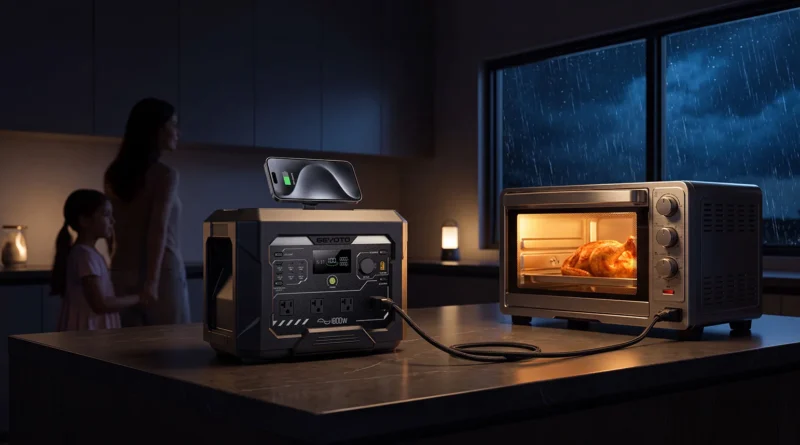
The N300 has nine output outlets and 25W wireless charging. The N1000 provides 18 total ports and interfaces, including 13 output ports, along with Qi2.2 25W wireless charging.
When comparing models, make sure the available connections match the devices you expect to use during an emergency.
Consider UPS Switching
A UPS, or uninterruptible power supply, can help reduce the interruption that occurs when utility electricity fails.
This can be useful for equipment such as Wi-Fi routers, computers, and other electronics that may restart or lose connectivity after a power interruption.
Both the N300 and N1000 have a specified UPS switching time of less than 10 milliseconds. Users should still verify compatibility with sensitive equipment and follow the manufacturer’s instructions.
Decide How Portable the Generator Needs to Be
The best emergency backup system should fit your intended environment.
If you live in an apartment, travel frequently, or want a unit for camping as well as emergency backup, a compact portable system may be more practical. Larger systems provide greater capacity and output but may require more storage space and effort to move.
Consider where the unit will be stored and where it will be used during an outage before choosing its size.
Consider Multiple Uses
Some homeowners want an emergency power system that can also be used for camping, RV trips, or vehicle-support situations.
The N1000 includes an XT60 vehicle-support output rated at 12.6V/30A, with up to 378W of output. This can add flexibility for compatible vehicle-support applications.
The N300, meanwhile, is positioned as a compact “Grab and Go” power solution for camping, travel, small electronics, Wi-Fi routers, laptops, lighting, and short-term outage backup.
Safety Should Be Part of the Decision
Safety requirements depend on the type of generator you choose.
Fuel-powered generators produce exhaust gases and require appropriate outdoor placement and ventilation. They should never be operated in enclosed spaces because of the risk of carbon monoxide accumulation.
Battery-based portable power stations do not use an internal combustion engine, but they should still be operated, charged, and stored according to the manufacturer’s safety instructions.
How to Compare Emergency Generators
Before making a decision, compare the features that directly affect your household’s needs:
- Battery capacity: Determines the amount of stored energy.
- Continuous output: Shows the normal power the system can provide.
- Peak output: Helps accommodate temporary startup demands.
- Constant Power capability: May support compatible higher-power loads within specified limits.
- Recharge time: Determines how quickly the system can be prepared for another outage.
- Battery chemistry: Provides insight into the type of battery technology used.
- Cycle life: Helps evaluate suitability for repeated use.
- Ports and interfaces: Determines how many and what types of devices can be connected.
- UPS functionality: Can help reduce interruptions for compatible electronics.
- Portability: Matters when the generator needs to be moved or used in different locations.
Final Thoughts
Choosing an emergency generator is mainly about matching the system to your household’s actual power requirements. A compact unit may be enough for communications, lighting, networking equipment, and other small electronics, while a higher-capacity system may be necessary for refrigerators, medical equipment, fans, and multiple appliances.
Start by identifying your essential loads and checking their wattage. Then compare capacity, continuous and peak output, recharge speed, battery technology, available ports, UPS capability, and portability. A careful comparison can help ensure that your backup power system is ready when the next outage occurs.