The Hidden Costs of Cheap Chicken Coops (And What to Look for Instead)
A low-priced chicken coop can seem like a smart starting point, especially for first-time backyard chicken keepers trying to manage costs. But the cheaper option often becomes more expensive over time once repairs, upgrades, cleaning issues, and flock stress start to add up. If you are comparing a chicken coop with run, the better decision is usually the one that saves time, reduces problems, and lasts through changing weather and flock needs.
Why Cheap Chicken Coops Are So Tempting
It is easy to see why budget coops sell so well. They look affordable, compact, and beginner-friendly. For someone setting up a small backyard flock, a low price tag can feel like the safest way to get started without making a major commitment.
There is also a common assumption that all chicken coops do the same basic job. If one coop has a nesting box, a few perches, and an enclosed space, it can be hard to tell at a glance why one costs more than another. Product photos can make nearly every coop look tidy and functional, even when the materials and layout are not designed for long-term use.
The problem is that a coop is not just a shelter. It is part housing system, part security system, and part daily maintenance setup. When any of those parts fail, the real cost appears.
The Hidden Costs of a Cheap Chicken Coop
Repair and replacement costs add up quickly
One of the biggest hidden expenses is how often low-cost coops need repair. Thin wood panels, weak screws, light hinges, and cheap roofing materials may hold up for a short time, but they often struggle once exposed to regular sun, rain, wind, and moisture.
Warped doors stop closing properly. Roof panels begin to lift or leak. Latches loosen. Wooden legs soften or crack near the base. Small design weaknesses that seem minor at first can turn into constant upkeep. That means more money spent on sealants, replacement hardware, patch materials, and eventually a new coop.
In many cases, the lower upfront price simply shifts the cost into the months ahead. Instead of buying once and using it confidently, owners end up managing a series of small failures that were built into the product from the beginning.
Poor predator protection can become a serious problem
A cheap coop may provide enclosure, but that does not always mean real security. Predator risks are one of the most expensive and stressful consequences of choosing the wrong build quality. Weak mesh, loose framing, poor door alignment, and simple twist latches may not be enough to keep out raccoons, foxes, snakes, or neighborhood dogs.
This is where the difference between looking secure and being secure really matters. A coop can appear enclosed while still having weak points around the run, nesting box lid, ventilation opening, or lower frame edge. Even a small gap or a weak fastening point can become a major vulnerability.
The cost here is not only financial. Losing birds, dealing with injuries, or constantly reinforcing the structure after purchase can quickly turn a bargain into a regret. Security should be treated as a core feature, not an upgrade to figure out later.
Small layouts often mean overcrowding
Another hidden cost shows up in the way capacity is marketed. Many low-cost coops advertise how many chickens they can hold, but those numbers are often based on minimum space, ideal bird size, and best-case conditions. In real backyard use, a coop that claims to fit a certain number of hens may feel crowded much sooner.
Overcrowding affects more than comfort. It can lead to pecking, stress, dirty nesting areas, poor sleep space on the roost, and more territorial behavior. If birds cannot move comfortably between the enclosed area and the outdoor section, the entire setup becomes harder to manage.
This usually creates a second expense. Owners either have to reduce flock size, buy extensions, or replace the coop far earlier than expected. What looked affordable on day one becomes a temporary purchase rather than a real solution.
Cheap coops are often harder to clean than they look
A poorly designed coop can cost you in time and effort every single week. This is one of the least obvious issues when shopping online, because product images tend to focus on appearance rather than maintenance.
In practice, cleaning becomes frustrating when a coop has tight corners, awkward access doors, fixed floor panels, or low roof clearance. Bedding collects in areas that are hard to reach. Moisture stays trapped in wood seams. Droppings gather under roosts with no easy way to remove them. Before long, routine cleaning takes much longer than expected.
That extra labor matters. A coop that is hard to clean is more likely to stay dirtier for longer periods. That affects odor, fly activity, moisture control, and overall flock hygiene. The hidden cost is not only your time, but also the effect on daily management and bird health.
Weather resistance is where cheap builds often fail
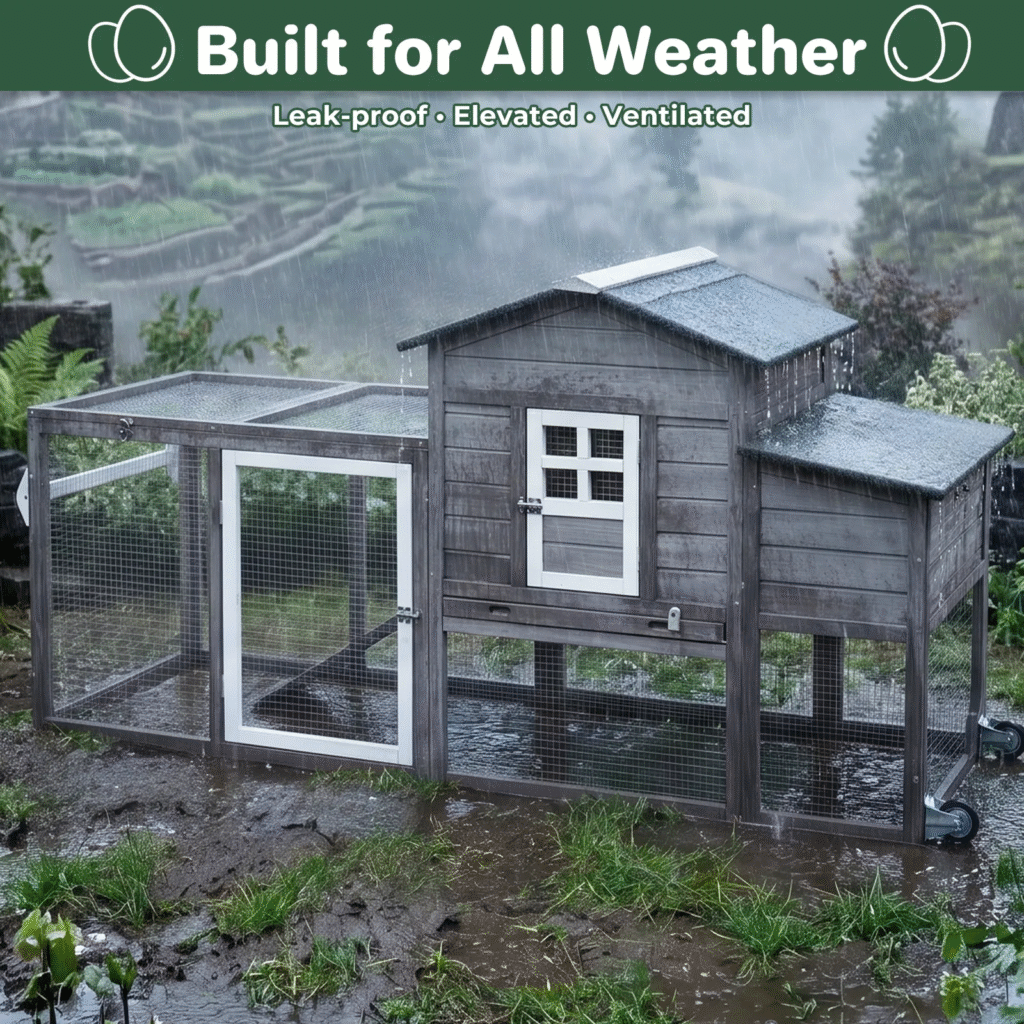
Outdoor housing needs to handle real conditions, not just look attractive in a product listing. Rain, direct sunlight, cold mornings, humidity, and seasonal temperature swings all test the quality of a coop. Budget models often struggle in exactly these conditions.
Roofing may absorb water instead of shedding it well. Wood can swell, split, or soften. Paint or surface treatments may wear off quickly. Ventilation openings may be poorly placed, creating drafts in cold weather or stale air in hot weather. Even the floor can become a problem if it holds moisture or sits too close to wet ground.
The result is a coop that ages fast and becomes uncomfortable for the birds. When weather protection is weak, owners often end up buying extra covers, adding waterproof layers, improving drainage, or moving the unit more often than planned. Again, the savings disappear.
Limited expandability can force an early upgrade
A flock rarely stays exactly the same for long. People add a few more hens, separate birds temporarily, or realize they need more run space than expected. Cheap coops are often built as fixed units with little room to adapt.
That lack of flexibility creates another hidden cost. Instead of improving an existing setup, the owner has to replace it. A coop that cannot accept extra run panels, connect to a second enclosure, or support a growing flock becomes a short-term purchase.
This is especially frustrating because many people do not intend to expand at first. But once the flock settles in and confidence grows, their needs change. A coop that works only under the most limited conditions can become restrictive very quickly.
What to Look for Instead
Choose materials that are built for outdoor use
The first upgrade is not about appearance. It is about structure. A better coop should use materials that can handle daily outdoor exposure without rapidly breaking down. That includes stronger wood, more reliable hardware, durable wire, and roofing materials designed to resist moisture.
Solid framing matters because it affects everything else, from door alignment to long-term stability. Better materials cost more at the start, but they reduce the cycle of patching, replacing, and reinforcing that makes cheap coops expensive in the long run.
When evaluating a coop, think less about decorative styling and more about whether the materials support year-round use.
Prioritize real security features
Predator resistance should be one of the first things you check, not something buried near the end of your comparison. Look closely at how doors close, how wire is attached, how lids are secured, and whether the run area feels genuinely reinforced.
A good coop should not depend on luck. It should be designed with the idea that animals will test the weak points. Strong mesh, dependable locks, solid framing, and well-secured access points all matter more than surface appearance.
If a coop looks lightweight in the wrong places, it probably is.
Buy for real flock size, not the smallest acceptable size
It is always better to buy based on comfortable daily use than on the maximum number printed on a listing. Think about the actual size of your birds, how much time they will spend confined, and whether you may add to the flock later.
Enough roosting space, accessible nesting areas, and a usable run are all part of proper sizing. A coop that feels slightly generous at the start often proves to be the smarter purchase because it reduces stress and avoids a quick upgrade.
Space is not wasted when it improves flock welfare and daily management.
Look for designs that make cleaning easier
Maintenance-friendly features save real time over the life of a coop. Wide access doors, pull-out trays, smoother interior surfaces, and practical nesting box placement all make a difference. These details may not look exciting in a product photo, but they are what determine whether routine care feels manageable.
A good cleaning design also supports better hygiene. When waste is easier to remove and damp areas are easier to inspect, the coop is more likely to stay dry and cleaner overall. That reduces odor, improves comfort, and makes the entire setup easier to manage week after week.
Think about weather from day one
Do not assume that all outdoor coops are equally weather-ready. Pay attention to roof construction, drainage considerations, airflow, and how exposed the run and enclosed area will be in your yard.
A coop that handles weather well protects both the birds and the investment. It lasts longer, stays more stable, and reduces the need for constant adjustments after every heavy rain or temperature shift. Weather resistance is not a bonus feature. It is part of the basic job.
Consider expandability before you need it
Even if you are starting with a small flock, it makes sense to think ahead. A coop that can be expanded or paired with additional enclosed space gives you more options later. That kind of flexibility can extend the life of your setup and delay or eliminate the need for full replacement.
Future-proofing does not mean buying the largest model possible. It means choosing a structure that gives you room to adapt.
A Cheap Coop Is Only Cheap If It Lasts
The real question is not whether a coop is inexpensive at checkout. The real question is whether it continues to do its job without draining your time, budget, and energy over the next year.
A cheap chicken coop often becomes expensive through repairs, upgrades, security fixes, cleaning frustration, and early replacement. A better-built coop may cost more upfront, but it usually delivers better value because it protects the flock, simplifies routine care, and remains useful as your setup evolves.
Price matters, but price alone is not value.
Conclusion
Buying a chicken coop based only on the lowest price is one of the most common mistakes new backyard chicken keepers make. What looks affordable at first can lead to higher long-term costs in maintenance, lost time, poor security, and flock stress.
A better approach is to look for durability, usable space, easy cleaning, weather resistance, and room to grow. When you judge a coop by how well it performs over time rather than how cheap it looks on day one, you are much more likely to make a purchase that actually saves money.