
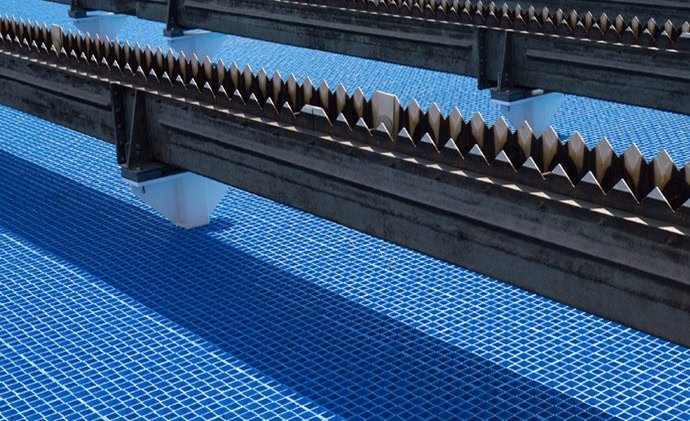
How Tube Settlers Improve Sedimentation Efficiency in Water and Wastewater Treatment Plants
Sedimentation is an essential process in water and wastewater treatment because it helps remove suspended particles before water moves to subsequent treatment stages. Conventional settling tanks rely on gravity to separate heavier particles from water, but their efficiency can be limited by tank size, hydraulic loading, and particle settling characteristics. As treatment facilities face increasing demands for better water quality and higher processing capacity, improving sedimentation performance has become increasingly important.
One practical solution is the Tube Settler, a compact settling enhancement technology designed to improve the separation of suspended solids. It uses multiple inclined tubes or channels to increase the effective settling area within a sedimentation tank. This arrangement allows particles to settle over shorter distances, helping treatment plants improve clarification efficiency, optimize available space, and achieve more consistent water quality.
What Is a Tube Settler?
A tube settler is a sedimentation enhancement device consisting of multiple inclined tubes arranged together in a modular structure. These tubes are commonly manufactured from materials such as PVC or polypropylene, depending on the application and operating conditions.
The primary purpose of a tube settler is to increase the effective settling surface area inside a clarification tank. Instead of requiring suspended particles to travel through the entire depth of a conventional settling basin, the inclined tubes provide shorter settling distances.
As water flows through the channels, suspended particles move toward the tube surfaces and settle under gravity. The accumulated solids slide downward along the inclined surfaces and collect at the bottom of the tank for removal.
This process improves the use of available tank volume and supports more efficient solid-liquid separation.
How Do Tube Settlers Work?
Tube settlers operate on the principle of gravity sedimentation. Their inclined channel arrangement helps suspended particles settle more quickly by reducing the distance they need to travel.
The process generally involves the following stages.
1. Entry of Water into the Sedimentation Tank
Water enters the clarification tank after preliminary treatment or chemical conditioning, depending on the treatment process.
In many water treatment plants, coagulation and flocculation occur before sedimentation. These processes help smaller suspended particles combine into larger flocs that are easier to settle.
2. Distribution Through Inclined Tubes
The incoming water is distributed through the inclined tube channels. Proper flow distribution is important because uneven hydraulic conditions can reduce settling performance.
The tube arrangement creates multiple small settling zones within the tank, increasing the available effective settling area.
3. Separation of Suspended Particles
As water moves upward through the inclined channels, heavier suspended particles settle onto the tube surfaces under gravity.
The inclined orientation allows accumulated solids to move downward toward the bottom of the tank. This helps separate settled particles from the clarified water.
4. Collection of Clarified Water
The clarified water moves toward the collection system at the top of the sedimentation unit.
Depending on the treatment plant design, it then flows to filtration, disinfection, or another treatment stage.
5. Sludge Collection and Removal
Settled particles accumulate in the sludge collection zone at the bottom of the tank.
The sludge is periodically or continuously removed through suitable collection equipment to prevent excessive accumulation and maintain stable operation.
Major Benefits of Using Tube Settlers in Treatment Plants
Tube settlers offer several advantages for facilities that need to improve sedimentation performance without constructing significantly larger settling tanks.
1. Increased Sedimentation Efficiency
The multiple inclined channels provide a greater effective settling area within the existing tank volume.
This allows suspended particles to settle over shorter distances and improves the overall efficiency of solid-liquid separation.
2. Higher Hydraulic Loading Capacity
Tube settlers can help sedimentation tanks process greater water flows when the system is properly designed.
Because the available settling area is increased, plants may be able to handle higher hydraulic loading rates compared with conventional settling arrangements.
However, actual capacity depends on flow distribution, particle characteristics, tank configuration, and operating conditions.
3. Reduced Space Requirements
Constructing larger sedimentation tanks can be expensive and difficult, particularly in urban areas or facilities with limited land.
Tube settler modules improve the effective settling area within existing tank dimensions, making them useful for compact treatment plant designs.
4. Improved Water Clarity
By supporting better suspended solids separation, tube settlers help reduce turbidity in clarified water.
This can improve the performance of downstream filtration systems and reduce the solids load reaching subsequent treatment stages.
5. Potentially Lower Construction Costs
Tube settler installations can increase the capacity of suitable existing sedimentation tanks without requiring complete structural expansion.
This may reduce the need for additional land and major civil construction, although installation costs depend on tank modifications and supporting equipment.
6. Modular Installation
Tube settlers are generally supplied in modular arrangements that can be installed according to tank dimensions and treatment requirements.
Their modular design can simplify installation, replacement, and maintenance when appropriate access and support structures are provided.
Types of Tube Settler Arrangements
Tube settlers are available in different configurations to accommodate various tank designs and treatment requirements.
Inclined Tube Settlers
Inclined tube settlers use channels positioned at a specific angle to encourage settled particles to slide downward.
The angle is selected according to the module design, particle characteristics, and hydraulic conditions. These systems are widely used in conventional sedimentation and clarification applications.
Hexagonal Tube Modules
Some tube settler systems use hexagonal channel structures arranged in a honeycomb pattern.
This configuration provides multiple settling passages within a compact module and helps distribute flow across the available surface area.
PVC Tube Settlers
PVC tube settlers are commonly used because of their lightweight construction and resistance to many water treatment environments.
They can be manufactured in different dimensions and configurations to suit specific clarification requirements.
Polypropylene Tube Settlers
Polypropylene modules offer another material option for applications requiring suitable chemical resistance and mechanical properties.
The choice between PVC, polypropylene, and other materials depends on water characteristics, temperature, installation conditions, and expected service life.
Applications of Tube Settlers in Water and Wastewater Treatment
Tube settlers are used in different treatment processes where efficient gravity separation of suspended solids is required.
Drinking Water Treatment Plants
In drinking water facilities, tube settlers improve sedimentation after coagulation and flocculation.
They help remove suspended particles and reduce the turbidity of water before filtration and disinfection.
Municipal Wastewater Treatment
Municipal wastewater treatment plants use clarification processes to separate suspended solids from wastewater.
Tube settlers can improve the performance of suitable settling units and support better solids removal before downstream treatment.
Industrial Wastewater Treatment
Industrial wastewater may contain suspended particles generated by manufacturing, processing, and cleaning operations.
Tube settlers can help separate these solids after suitable pretreatment, coagulation, or flocculation.
Stormwater Treatment
Stormwater runoff can carry soil particles, sediment, and other suspended materials into drainage and treatment systems.
Tube settler technology may support sedimentation in appropriately designed stormwater treatment facilities.
Water Recycling and Reuse Facilities
Facilities that recycle process water need effective solids separation to protect downstream equipment and improve water quality.
Tube settlers can serve as part of a treatment arrangement that includes filtration and other polishing processes.
Tube Settlers Compared with Conventional Sedimentation Tanks
Conventional sedimentation tanks depend on gravity and available tank surface area to separate suspended particles. Tube settlers enhance this process by introducing additional inclined settling surfaces.
| Comparison Factor | Conventional Sedimentation | Tube Settler System |
|---|---|---|
| Settling arrangement | Open tank settling | Multiple inclined channels |
| Effective settling area | Limited by tank dimensions | Increased through tube surfaces |
| Hydraulic capacity | Depends on conventional tank design | Can support higher loading when properly designed |
| Space utilization | Requires sufficient settling area | Uses tank volume more efficiently |
| Installation | Basic tank arrangement | Requires tube modules and support structures |
| Maintenance | Tank and sludge removal maintenance | Includes tank, sludge, and tube cleaning inspections |
Tube settlers do not replace the basic principles of sedimentation. Instead, they enhance the process by providing additional settling surfaces and shorter particle settling distances.
Important Factors for Selecting the Right Tube Settler
Choosing an appropriate tube settler system requires careful consideration of treatment requirements and site conditions.
Tube Diameter and Channel Dimensions
The dimensions of the channels influence hydraulic flow, particle movement, and the likelihood of clogging.
Smaller channels may provide greater surface area but can be more vulnerable to blockage when wastewater contains excessive solids.
Inclination Angle
The tube inclination helps accumulated particles slide downward toward the sludge collection zone.
The selected angle should support effective solids removal while maintaining the required hydraulic performance.
Material Quality
Tube settlers are manufactured from different materials depending on their intended application.
Material selection should consider chemical exposure, water temperature, ultraviolet exposure where relevant, and mechanical strength.
Hydraulic Loading Rate
The hydraulic loading rate determines how much water passes through the available settling area.
Excessive flow can cause particle carryover and reduce clarification efficiency. Proper sizing and flow distribution are therefore essential.
Water Characteristics
The size, density, and concentration of suspended particles affect settling performance.
Facilities should evaluate incoming turbidity, solids concentration, and the effectiveness of coagulation and flocculation before selecting a system.
Maintenance Practices for Long-Term Performance
Although tube settlers have a relatively simple structure, regular inspection and cleaning are important for maintaining their performance.
Recommended maintenance activities include:
- Inspecting tube modules for physical damage or deformation.
- Removing accumulated deposits that may cause channel blockage.
- Checking inlet and outlet flow distribution.
- Monitoring turbidity and suspended solids in treated water.
- Ensuring that sludge collection equipment operates correctly.
- Inspecting support structures and module positioning.
- Cleaning the modules when necessary using methods compatible with their construction material.
Proper sludge removal is particularly important because excessive accumulation can interfere with sedimentation and cause solids to re-enter the water flow.
How Tube Settlers Contribute to Sustainable Water Treatment
Efficient sedimentation helps reduce the amount of suspended material entering downstream treatment processes.
By improving solids separation, tube settlers can support better filtration performance and help treatment plants manage water more efficiently. Their ability to enhance existing clarification tanks may also reduce the need for extensive structural expansion.
In wastewater applications, improved clarification can contribute to more consistent effluent quality and better overall process control.
However, tube settlers primarily support physical sedimentation. They do not independently remove dissolved pollutants, pathogens, or all chemical contaminants. Additional treatment stages remain necessary to meet specific water quality and reuse requirements.
Conclusion
Tube settlers improve sedimentation efficiency by increasing the effective settling area inside water and wastewater treatment tanks. Their inclined channel design reduces particle settling distances, supports better suspended solids separation, and allows suitable clarification units to handle higher hydraulic loading rates.
With benefits such as improved water clarity, efficient space utilization, modular installation, and potential treatment capacity improvements, tube settlers are a valuable component of modern water treatment infrastructure. Selecting the correct module dimensions, material, inclination, and hydraulic configuration is essential for achieving reliable performance and maintaining consistent water quality.


