
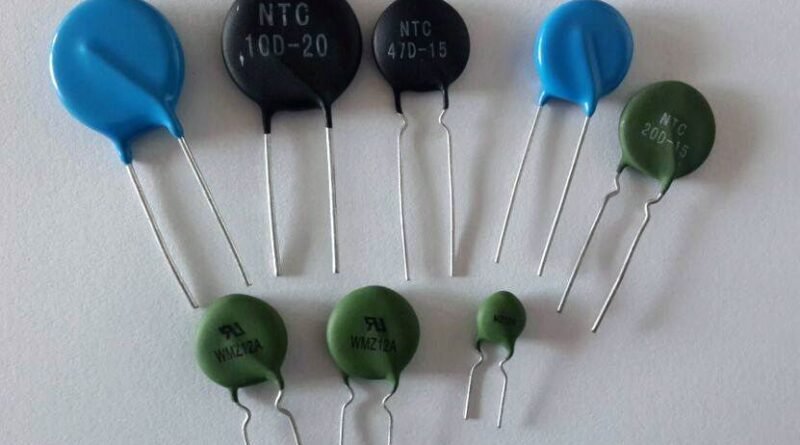
Understanding Thermistor Components and Their Role in Temperature-Sensitive Circuits
Temperature plays an important role in the operation, safety, and efficiency of electronic devices. Many circuits require accurate temperature monitoring or automatic responses to changing thermal conditions. Thermistors are widely used for these purposes because their electrical resistance changes noticeably with temperature. Their sensitivity makes them valuable in consumer electronics, industrial equipment, automotive systems, and temperature control applications.
A Thermistor Component is a temperature-sensitive resistor designed to change its resistance according to variations in surrounding or operating temperature. Depending on its type, the resistance may decrease or increase as temperature rises. This behavior allows engineers to use thermistors for temperature measurement, circuit protection, compensation, and automatic control. Understanding their operating principles and characteristics helps designers select suitable components for different electronic applications.
What Is a Thermistor?
A thermistor is a type of resistor whose electrical resistance varies significantly with temperature. The term comes from combining the words “thermal” and “resistor.” Unlike ordinary resistors, which are generally designed to maintain a relatively stable resistance, thermistors are specifically manufactured to respond to temperature changes.
Thermistors are commonly made from semiconductor materials, including metal oxides and ceramic compounds. Their resistance-temperature characteristics depend on the materials, manufacturing process, and intended operating range.
Because thermistors can detect relatively small temperature changes, they are useful in circuits that require thermal monitoring and control.
Types of Thermistors
Thermistors are mainly divided into two categories: Negative Temperature Coefficient (NTC) and Positive Temperature Coefficient (PTC). Each type has a different resistance response to temperature.
1. Negative Temperature Coefficient (NTC) Thermistors
NTC thermistors have resistance values that decrease as temperature increases. When the temperature falls, their resistance rises.
This characteristic makes NTC thermistors suitable for accurate temperature measurement and monitoring. They are commonly used in digital thermometers, battery management systems, HVAC equipment, and electronic temperature control circuits.
NTC thermistors are also used as inrush current limiters. Their initially high resistance helps restrict the current surge when certain electrical devices are switched on. As the thermistor warms up, its resistance decreases, allowing normal operating current to flow more easily.
2. Positive Temperature Coefficient (PTC) Thermistors
PTC thermistors behave differently because their resistance increases as temperature rises. Some PTC devices show a particularly sharp resistance increase around a specified switching temperature.
This characteristic makes them useful in overcurrent protection, temperature monitoring, motor protection, and self-regulating heating applications.
When an abnormal current or temperature condition occurs, a PTC thermistor can increase its resistance and restrict current flow, helping reduce the risk of overheating or component damage.
How Does a Thermistor Work?
A thermistor operates by converting temperature changes into measurable electrical resistance changes. When its temperature changes, the electrical properties of the semiconductor material also change.
In an NTC thermistor, increasing temperature generally allows charge carriers to move more easily through the material, reducing electrical resistance. In a PTC thermistor, resistance increases with temperature, particularly near its designed transition region.
An electronic circuit can measure the resulting resistance change directly or convert it into a voltage using a voltage divider. A microcontroller or other control circuit can then interpret the voltage to estimate temperature and initiate an appropriate response.
For example, a temperature monitoring circuit may activate a cooling fan when the thermistor detects that a device has reached a specified temperature.
Key Characteristics of Thermistor Components
Several electrical and physical characteristics determine how a thermistor performs in a particular application.
1. Resistance at a Reference Temperature
Thermistors are commonly specified by their nominal resistance at a reference temperature, often 25°C. Common NTC values include 1 kΩ, 10 kΩ, and 100 kΩ, although many other resistance ratings are available.
The correct nominal resistance depends on the measurement circuit and required temperature range.
2. Temperature Coefficient
The temperature coefficient describes how resistance changes in response to temperature variation. NTC thermistors have a negative temperature coefficient, while PTC thermistors have a positive one.
This property determines whether the component is suitable for temperature sensing, protection, or compensation.
3. Operating Temperature Range
Every thermistor has a specified operating temperature range. Selecting a component that can withstand the expected environmental and operating temperatures is essential for reliable performance.
4. Accuracy and Tolerance
Thermistor accuracy depends on resistance tolerance, material consistency, calibration, and the measurement circuit. Some applications require highly accurate temperature readings, while others only need approximate thermal detection.
5. Response Time
Response time indicates how quickly a thermistor reacts to changes in temperature. It depends on the component’s size, construction, packaging, and surrounding environment.
Small thermistors often respond more quickly than larger components because they generally have less thermal mass.
6. Dissipation Constant
The dissipation constant describes how much power is required to raise the thermistor’s temperature by a specified amount under defined conditions. It is important because excessive measuring current can cause self-heating and affect temperature accuracy.
Applications of Thermistor Components in Electronic Circuits
Thermistors are used in many electronic systems because they provide a simple and effective way to detect and respond to temperature changes.
1. Temperature Measurement
One of the most common applications is temperature sensing. NTC thermistors are frequently incorporated into digital thermometers, household appliances, medical equipment, and environmental monitoring systems.
Their resistance changes are converted into temperature readings through suitable electronic circuits.
2. Overheating Protection
Electronic components can become damaged when they operate beyond their safe temperature limits. Thermistors can monitor the temperature of motors, batteries, power supplies, and semiconductor devices.
A protection circuit can use the thermistor’s output to trigger an alarm, reduce operating power, or shut down equipment when excessive heat is detected.
3. Inrush Current Limiting
NTC thermistors are often installed in power supply circuits to reduce the initial current surge that occurs when equipment is switched on.
At startup, the thermistor has relatively high resistance, limiting the current. As it warms up, its resistance decreases and allows the circuit to operate normally.
4. Battery Management Systems
Rechargeable batteries require careful temperature monitoring during charging and discharging. Thermistors are commonly placed near battery cells to detect temperature changes.
Battery management systems use this information to adjust charging conditions or stop operation when unsafe thermal conditions are detected.
5. HVAC and Climate Control
Heating, ventilation, and air conditioning systems use thermistors to measure air, surface, and equipment temperatures.
Their readings help controllers regulate heating and cooling operations, maintain comfortable indoor conditions, and improve energy management.
6. Temperature Compensation
Some electronic components change their electrical characteristics as temperature varies. Thermistors can be included in compensation circuits to help maintain more stable performance.
This approach is useful in measurement equipment, oscillators, power circuits, and other temperature-sensitive designs.
Advantages of Using Thermistors
Thermistors offer several benefits that make them popular in temperature-sensitive electronic circuits.
- High temperature sensitivity: They can detect relatively small temperature changes.
- Compact size: Many thermistors are small enough to fit into space-constrained electronic assemblies.
- Fast response: Suitable designs can react quickly to changes in temperature.
- Cost-effectiveness: Thermistors are generally affordable and available in many resistance ratings.
- Simple circuit integration: They can be connected to voltage dividers and other straightforward measurement circuits.
- Multiple application options: NTC and PTC types support temperature sensing, current limiting, and circuit protection.
These benefits make thermistors practical for both basic electronic products and sophisticated industrial systems.
Factors to Consider When Selecting a Thermistor
Choosing the right thermistor requires matching its specifications to the circuit’s electrical and thermal requirements.
Thermistor type: Determine whether an NTC or PTC device is appropriate for the intended function.
Nominal resistance: Select a resistance value that works with the measurement or control circuit.
Temperature range: Ensure the component can operate safely across the expected minimum and maximum temperatures.
Accuracy requirements: Check resistance tolerance and temperature accuracy for applications requiring precise measurement.
Response time: Consider how quickly the thermistor must react to temperature changes.
Physical construction: Choose a suitable package, probe, lead configuration, or mounting arrangement based on the installation environment.
Power rating: Ensure the component can handle the expected electrical power without excessive self-heating.
Common Challenges When Using Thermistors
Although thermistors are useful and versatile, their characteristics introduce certain design considerations.
One common challenge is nonlinear resistance behavior. The relationship between temperature and resistance is not usually linear, particularly for NTC thermistors. Accurate temperature measurement may therefore require calibration, lookup tables, or mathematical conversion.
Self-heating is another concern. If excessive current passes through the thermistor, it can heat itself and produce a reading that differs from the surrounding temperature.
Environmental conditions can also influence performance. Moisture, mechanical stress, poor thermal contact, and unsuitable mounting arrangements may reduce measurement accuracy or component lifespan.
Careful circuit design, correct component selection, and appropriate installation help address these challenges.
Conclusion
Thermistor components play an important role in modern electronic circuits by converting temperature changes into measurable resistance variations. NTC thermistors are commonly used for temperature sensing and inrush current limiting, while PTC thermistors support overcurrent protection, thermal monitoring, and self-regulating applications.
Their sensitivity, compact size, affordability, and simple integration make them valuable in consumer electronics, automotive systems, industrial equipment, battery management, and HVAC applications. By understanding their operating principles, electrical characteristics, and selection requirements, engineers can use thermistors to improve temperature monitoring, circuit protection, and overall electronic system reliability.