
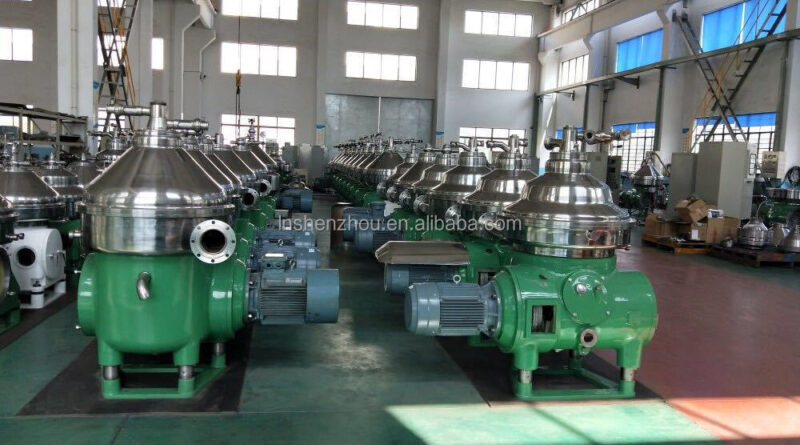
Selecting a Disc Stack Centrifuge for Continuous Processing
Continuous processing requires separation equipment that can operate reliably for extended periods while maintaining consistent output. When a production line involves suspended solids, immiscible liquids, or fine particles, centrifugal separation can offer a practical alternative to slower batch-based methods.
Choosing the right Disc Stack Centrifuge requires more than comparing machine capacity. The characteristics of the feed material, desired separation result, operating conditions, and solids-handling requirements all influence which configuration is appropriate.
Start With the Separation Objective
The first step is to define exactly what the centrifuge needs to accomplish. Different processes may require clarification, liquid-liquid separation, or simultaneous removal of solids and separation of liquid phases.
For example, a process focused on producing a clear liquid may prioritize fine-particle removal, while an oil-processing application may require efficient separation of water and oil.
A clear separation objective makes it easier to determine the appropriate bowl design, discharge system, and operating parameters.
Evaluate the Feed Material
The composition of the incoming mixture has a major effect on centrifuge selection. Important characteristics include particle size, solids concentration, density, viscosity, and temperature.
Before choosing equipment, operators should obtain representative information about the feed rather than relying solely on general process descriptions.
Particle Size and Density
Larger particles generally respond more readily to centrifugal separation than extremely fine particles. The difference in density between the particles and liquid also affects how quickly separation occurs.
When particles are very small or have a density close to the liquid, stronger separation conditions or additional processing steps may be necessary.
Solids Concentration
The amount of solids entering the centrifuge determines how frequently solids need to be removed and how much load the machine must handle.
High-solids applications may require a configuration specifically designed for frequent or continuous solids discharge.
Consider the Required Throughput
Continuous production places particular importance on processing capacity. The centrifuge should be capable of handling the required feed rate without sacrificing the desired separation quality.
Selecting equipment based only on maximum rated capacity can be misleading. Actual performance may vary depending on feed viscosity, particle characteristics, solids concentration, and separation requirements.
It is generally better to evaluate capacity under conditions that closely resemble the real process.
Examine the Solids Discharge Method
How solids are collected and removed can have a major influence on continuous operation.
Some processes generate relatively small amounts of solids and can use periodic cleaning or manual removal. Others produce a continuous solids load and require automatic discharge.
When uninterrupted processing is important, the solids-handling arrangement should be considered alongside the separation performance rather than treated as a secondary feature.
Check Liquid Handling Requirements
Liquid outlet arrangements also need to match the intended process. A centrifuge may be configured primarily for clarification or for separating two liquid phases with different densities.
For liquid-liquid applications, the density difference between the phases is particularly important. Flow rates, viscosity, and the desired purity of each outlet should also be considered during equipment selection.
Account for Operating Conditions
Industrial centrifuges operate under demanding mechanical conditions, so the equipment must be compatible with the process environment.
Important considerations include:
- Operating temperature
- Feed pressure
- Liquid viscosity
- Chemical compatibility
- Required operating hours
- Cleaning procedures
- Installation conditions
For hygienic applications, such as food or pharmaceutical processing, cleaning and sanitation requirements may be especially important.
Look at Automation and Process Integration
Continuous processing works best when separation equipment can integrate smoothly with the rest of the production line.
Depending on the application, useful control functions may include monitoring of operating speed, temperature, vibration, feed conditions, and discharge cycles.
Automation can help maintain stable operating conditions and reduce the need for constant manual intervention. However, the appropriate level of automation depends on process complexity and production requirements.
Consider Maintenance Requirements
Reliability is not determined only by the centrifuge’s initial performance. Long-term maintenance requirements should also be evaluated.
Routine inspections, cleaning, lubrication where applicable, and monitoring for abnormal vibration can help identify potential problems before they become serious.
Operators should also consider how easily wear components can be inspected or replaced and whether routine maintenance can be performed without excessive production downtime.
Assess Energy and Operating Costs
Energy consumption is another factor when selecting equipment for continuous operation. A centrifuge may operate for many hours each day, so differences in power requirements can become significant over the equipment’s service life.
Total operating cost should also account for maintenance, cleaning, consumables, downtime, and solids-handling requirements rather than focusing only on initial purchase price.
Match the Equipment to the Process
There is no single centrifuge configuration that is ideal for every continuous application. A suitable selection should balance separation performance, throughput, solids handling, energy use, maintenance, and process compatibility.
Testing representative feed material can be particularly useful when the separation characteristics are uncertain. It provides a better indication of how the equipment is likely to perform under actual operating conditions.
Shenzhou Machinery is one manufacturer associated with centrifugal separation equipment for industrial applications, but equipment selection should ultimately be based on the specific requirements of the process.
Final Considerations
Selecting a disc stack centrifuge for continuous processing is a process-engineering decision rather than simply a capacity comparison. Feed characteristics, separation objectives, throughput, solids discharge, liquid handling, automation, maintenance, and operating costs all need to be evaluated together.
When these factors are properly matched, centrifugal separation can become a dependable part of a continuous production system, helping maintain consistent processing while reducing reliance on slower separation methods.