
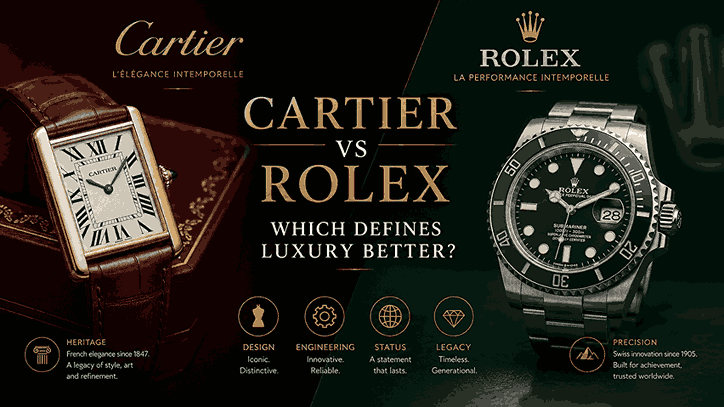
Cartier vs Rolex – Which Defines Luxury Better?
The concept of luxury in watchmaking has never been tied to precious materials or prices. Authentic luxury usually portrays the history, artisanship, exclusivity, and emotional worth. Cartier watches and Rolex watches are few names that symbolize these ideals. They both have influenced the perception of prestige in the world, but in such a dramatically different way. One is the artistic elegance of refinement and the other is the technical perfection and performance based on status. This opposition makes their comparison particularly interesting both to collectors and fans.
When individuals inquire whether Cartier or Rolex would be a better definition of luxury, they tend to be posing a larger question of what luxury is to them personally. Is it classic style based on tradition? Is it technical superiority and universal appeal? There are buyers who attach importance to the classiness of a dress watch, and there are buyers who attach importance to durability coupled with prestige. Cartier and Rolex still dominate because they offer different solutions to these two desires, and two meanings of luxury.
Cartier and Rolex: Two Icons, Two Philosophies
Cartier started as a jeweler much earlier when it was turned into a watchmaking legend. Cartier started out as a jeweler before it became an iconic watch brand. It earned its fame through creativity, exclusivity and innovation. Cartier watches have commonly crossed the boundary between jewelry and horology with watches that are as practical as they are pretty. Tank and Santos are timeless icons of style, demonstrating that being luxurious does not require flashiness, but instead a certain level of sophistication and connection to the traditions of design, instead of being a show of strength.
In its turn, Rolex constructed its image of accuracy, longevity, and innovativeness. Milestones that made the brand synonymous with performance included waterproof cases, automatic movements and professional tool watches that were used by explorers and divers. Rolex watches exude luxury through success and dependability. They tend to be attractive because they are recognizable everywhere and owning a Rolex is a status of success that only a handful of brands can convey. This difference has defined the discourse of luxury over the ages.
Design Language and Brand Identity
Where the difference between these brands can be seen at first glance is design. Cartier watches are known for their non-round shapes. Rectangles, squares and curves are trademarks of the house. Roman numerals, blued hands and beautiful proportions are all the elements that give a visual identity a feel which is undeniably sophisticated. Cartier tends to attract individuals who desire their watch to reflect sophistication by artistic flair as opposed to mechanical ambiance.
Rolex watches do not follow this trend, but instead they build on the previous achievements. Consistency has made the Oyster case, rotating bezels, and clean dial designs iconic. Rolex adds few innovations, creating a perception of timelessness. This conservative style has produced some of the most famous watch designs in the world. To most people, luxury is something you can see at first glance and Rolex does this with an unparalleled confidence and consistency.
Another difference in the lifestyle of these brands is their way of wearing. Cartier is usually worn with formal attire, artistic careers, and people who prefer vintage style. Rolex is often a complement to active lifestyles, business-related environments and the status-conscious customers. The two approaches are not necessarily better than each other but they influence the differing views of luxury. Cartier implies taste, whereas Rolex can be an indication of achievement. Which image is more likely to resonate with the wearer can be the answer to which comes out as a better definition of luxury.
Craftsmanship and Innovation Compared
Luxury that lacks an artisanship cannot be sustained long and the two brands are better in this area though they have different priorities. Cartier has brought watch making to a new level of well worked out cases, beautiful dial, and more elegant in house movements. Cartier has invested heavily in horology, although it was a design house in the past. Its more complicated nature and the integrity of its pieces is evidence that it has more depth in its technical work that even its aesthetics and that its place among the esteemed watchmakers.
Rolex has a more engineering-oriented mindset towards craftsmanship. All the details, such as movement reliability, proprietary alloys, etc. are performance and long-lasting. The watches by Rolex are known to be durable, which can last decades with proper maintenance. This reliability adds a lot to their luxurious nature. To a large number of owners, the value proposition is knowing that a watch can withstand day-to-day wear and still be accurate.
The brands are also distinct in subtle ways due to innovation. Cartier has frequently been innovative in form and creative design, pioneering shapes and visual codes subsequently adopted throughout the industry. Rolex has also been at the forefront of innovation with practical innovations that have changed the standards of watchmaking. These two methods are important, though they are indicative of varying definitions of excellence. One is aesthetic originality and the other is technical progression. Luxury may be brought about by either of these philosophies, according to what the wearer values the most.
Prestige, Heritage, and Cultural Influence
Not many brands can compete with Cartier in terms of cultural impact. Since the times of royalty, through to artists and tastemakers, Cartier watches have been synonymous with high-society. The brand has a romantic touch of Parisian style and historic patronage. Cartier frequently conveys a more discreet sense of assurance, attracting the people who believe in tradition that is thought-provoking and sophisticated. This cultural baggage adds to the meaning of luxury that Cartier assigns to luxury in a sense not related to materialism.
The modern prestige of the watch brand may be none stronger, however, than Rolex. Rolex watches have become associated with success because of its dominance in sports, business, entertainment, and success stories. Being a Rolex owner is a milestone to many consumers. The aspirational dimension is an influential luxury since it relates the object to ambition. Not many brands have managed to make their name serve as a sort of shorthand that would become the universal icon of some sort of prestige.
The buying decisions are frequently influenced by the cultural perception rather than craftsmanship. Cartier can attract people who want to achieve discreet difference, whereas Rolex can attract those who want to gain wider recognition. Interestingly, these reputations are not by accident. The two brands have developed their identities throughout the decades. This market has allowed each to dominate a aspect of luxury and classifications are now more refined than simply declaring one superior to the other.
Investment Value and Long-Term Ownership
Rolex can be at a distinct advantage, as far as long-term value is concerned. There are numerous Rolex watches that retain high resale values and some models have demonstrated high appreciation. This has further solidified Rolex as a luxury buy and as an asset. To collectors, such financial stability can elevate the status of luxury due to the practicality, as well as the aspirational nature of ownership.
Cartier watches have also received a greater interest of collectors, especially those iconic watches with a sustained demand. They may not necessarily draw the same resale prices as Rolex, but they frequently present an attractive value by comparison to their design importance. To the consumer who is less concerned with speculation, and wants to have a classic piece of Cartier to own forever, it can be a very fulfilling purchase. Luxury doesn’t always have to be measured on performance.
Resale is not the only owning experience. The quality of the service, durability, emotional connection, and wearability all do matter. Rolex usually wins in the day-to-day practicality and Cartier usually wins in style and comfort. A watch that has been worn, and has been appreciated, can be more valuable then a watch that has been bought for appreciation. At this stage, the discourse of luxury becomes personal and not numeric, it is no longer a matter of market but experience.
Which Brand Offers Greater Everyday Luxury?
Everyday luxury tends to be based on how a watch fits in life. Cartier watches offer the feel of casual elegance with the ability to elevate the ordinary. Even basic designs have an elegant aura that is special but does not command attention. To most wearers, such subdued style is indeed the epitome of luxury since it adds beauty to day to day life without screaming or preaching.
Rolex watches also provide another type of daily luxury that is founded on versatility and confidence. They move comfortably between workplaces and travelling, sports and formal. They are esteemed, but not less practical. Indeed, the fact that one can wear a highly regarded luxury watch every day without compromising is one of the reasons that make Rolex so attractive. In this perspective, luxury involves being out of delicateness.
The issue arises whether luxury is fragile and refined or sturdy and strong. Cartier leans in the direction of the former ideal, Rolex to the latter. Neither is incomplete. They are merely expressions of the different images of having something extraordinary.
Cartier vs Rolex: Which Defines Luxury Better?
In case artistic heritage, elegant design, and understated sophistication is the definition of luxury, Cartier might lead the race. Its identity is tied with the beauty in its purest form. Cartier watches are frequently enjoyed by people who appreciate cultivated taste over the publicity, and thus are potent symbols of taste.
When luxury is characterized by technical perfection, image and longevity of performance, Rolex can come out as the winner. Rolex watches have cultivated an unrivaled ownership and prosperity image across the globe. In the eyes of most human beings that mix is what modern day luxury is all about.
Cartier and Rolex have different definitions of luxury as opposed to having one crown each. Cartier is the epitome of style. Rolex symbolizes performance luxury. One is rhetorical, the other corporeal. Choosing between the two does not always depend on what one is objectively better and more, but what definition of luxury would suit the identity of the wearer.
Conclusion
The Cartier vs Rolex argument will continue to go on due to the fact that both brands lead in areas that it would be difficult to compare. Cartier watches are a symbol of class, tradition, and artistic value and are hard to match by other brands. The watches of Rolex are durable, prestigious, and recognizable that has become a standard of luxury in modern times. They both have become icons by being consistent and visionary.
It is a matter of perspective that determines how best luxury is defined. Cartier might not be in the same league with you, as long as you consider luxury to be exquisite beauty and old world elegance. Rolex may be better than the rest, in case you view luxury as a mark of achievement, novelty and permanence. The best conclusion can be that the two characterize luxury more than well each in his unique language. The more you can hear the more you should go with that decision.