
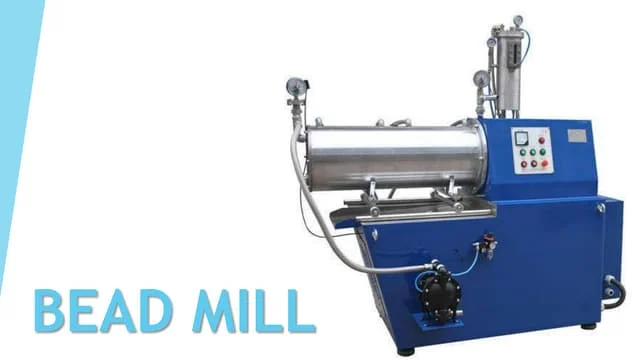
Understanding the Working Principle of a Wet Bead Mill
A wet bead mill is a powerful piece of equipment used for fine and ultra-fine particle size reduction in liquid media. It is widely applied in industries such as pharmaceuticals, coatings, food processing, and cosmetics, where uniform dispersion and precise particle sizing are essential. By combining mechanical forces with fluid dynamics, this technology ensures efficient and consistent grinding results.
At its core, a wet bead mill works by using small grinding media—known as beads—to break down solid particles suspended in a liquid. Many industries depend on a Wet Bead Mill to achieve high-quality dispersions that are difficult to produce with dry grinding methods. The process is continuous, controlled, and highly effective for producing fine particles.
Core Components of a Wet Bead Mill
To understand how the system works, it is important to look at its main components:
- Grinding chamber: A closed space where the milling process occurs
- Agitator or rotor: Drives the movement of the beads at high speeds
- Grinding media (beads): Small spheres that create impact and shear forces
- Feed pump: Introduces the slurry into the chamber
- Separator: Retains the beads while allowing processed material to exit
Each of these parts plays a critical role in maintaining efficiency and ensuring consistent results.
The Working Principle Explained
The operation of a wet bead mill involves several simultaneous actions that lead to effective particle size reduction.
1. Material Feeding
The process begins with feeding a slurry—a mixture of solid particles and liquid—into the grinding chamber. The liquid helps reduce friction, control temperature, and improve the flow of materials.
2. Agitation and Energy Transfer
Once inside the chamber, the agitator rotates at high speed. This motion causes the beads to move rapidly, generating intense energy within the system. The energy is transferred to the particles through:
- Impact forces from bead collisions
- Shear forces from the movement of liquid and beads
- Compression forces within the confined space
These combined forces are responsible for breaking down the particles.
3. Particle Size Reduction
As the particles are repeatedly subjected to impact and shear, they gradually decrease in size. The process continues until the desired level of fineness is achieved. This controlled grinding ensures a narrow particle size distribution.
4. Separation Process
A separator is used to retain the grinding media داخل the chamber while allowing the processed slurry to exit. This ensures continuous operation without losing the beads.
Key Advantages of the Working Principle
The design and working mechanism of a wet bead mill offer several advantages:
- Efficient grinding: High energy transfer leads to faster size reduction
- Uniform results: Consistent particle size distribution
- Temperature control: Liquid medium helps dissipate heat
- Continuous operation: Suitable for large-scale production
These benefits make wet bead mills a preferred choice for precision grinding applications.
Applications Across Industries
The effectiveness of the wet bead mill’s working principle makes it suitable for a wide range of industries:
Pharmaceuticals
Used to improve drug solubility and bioavailability by reducing particle size.
Paints and Coatings
Ensures even dispersion of pigments, resulting in smooth and high-quality finishes.
Food Processing
Helps achieve consistent textures in products such as sauces, pastes, and beverages.
Cosmetics
Provides uniform particle distribution for creams, lotions, and makeup products.
Factors That Affect Performance
Several variables influence how efficiently a wet bead mill operates:
- Bead size and material: Smaller beads produce finer particles
- Rotational speed: Higher speeds increase grinding intensity
- Viscosity of the slurry: Affects bead movement and energy transfer
- Processing time: Determines the final particle size
Optimizing these factors is essential for achieving the desired results.
Conclusion
Understanding the working principle of a wet bead mill highlights why it is such an effective solution for fine particle size reduction. By utilizing high-speed agitation, grinding media, and a liquid environment, it delivers consistent and efficient results across various industries.
As manufacturing processes continue to demand greater precision and efficiency, wet bead mills remain a key technology for achieving high-quality, finely dispersed materials.