MCB and MCCB: Key Differences, Applications, and Selection Guidelines
Electrical circuit protection is essential for maintaining safe and reliable power distribution in residential, commercial, and industrial environments. Electrical systems can experience faults such as overloads and short circuits, which may damage wiring, connected equipment, and distribution infrastructure. Circuit breakers help prevent these problems by automatically interrupting the electrical supply when abnormal current conditions occur. Two commonly used protective devices are Miniature Circuit Breakers (MCBs) and Molded Case Circuit Breakers (MCCBs).
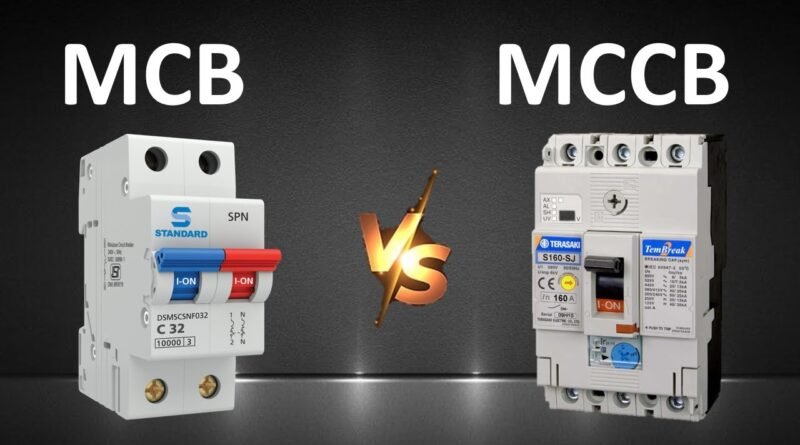
Understanding the differences between Mcb And Mccb is important when designing or upgrading an electrical installation. Although both devices provide protection against excessive current, they differ in their current ratings, breaking capacities, adjustment options, physical construction, and typical applications. Selecting the right breaker helps ensure that electrical circuits receive appropriate protection without unnecessary interruptions.
What Is an MCB?
A Miniature Circuit Breaker is an automatic electrical protection device commonly used in residential and light commercial installations. It protects electrical circuits against overloads and short circuits by disconnecting the power supply when excessive current is detected.
MCBs are designed for relatively low-current applications and are commonly installed in distribution boards to protect individual circuits.
Main Features of an MCB
- Compact construction: MCBs are designed to fit easily into standard distribution boards.
- Automatic tripping: They disconnect circuits when overload or short-circuit conditions occur.
- Fixed trip characteristics: Most standard MCBs have predefined operating characteristics.
- Manual operation: Users can switch the device on or off when required.
- Resettable design: After a fault has been identified and corrected, the breaker can generally be reset.
How Does an MCB Work?
An MCB typically uses thermal and magnetic mechanisms to detect excessive current.
The thermal mechanism responds to sustained overloads. It usually contains a bimetallic strip that heats up and bends when current remains above the permitted level. This movement activates the tripping mechanism.
The magnetic mechanism responds to sudden, high-current conditions such as short circuits. A strong magnetic effect activates the trip mechanism and disconnects the circuit rapidly.
These two mechanisms help protect electrical wiring and connected equipment against common overcurrent faults.
What Is an MCCB?
A Molded Case Circuit Breaker is a more robust circuit protection device designed for higher-current applications and electrical systems that may experience greater fault levels.
MCCBs are widely used in industrial facilities, commercial buildings, large distribution panels, and other installations where higher current ratings or advanced protection features are required.
Their molded insulating enclosure protects internal components and provides mechanical support.
Main Features of an MCCB
- Higher current ratings: MCCBs are available across a broader range of current ratings than typical MCBs.
- Greater breaking capacity options: Many models can interrupt higher short-circuit currents, depending on their specifications.
- Adjustable protection: Some MCCBs allow users to adjust thermal, magnetic, or electronic trip settings.
- Advanced trip units: Electronic models may provide additional protection functions.
- Accessory compatibility: Depending on the model, accessories may include auxiliary contacts, shunt trips, undervoltage releases, and motor operators.
- Industrial suitability: Their construction and available configurations support demanding electrical distribution applications.
How Does an MCCB Work?
An MCCB protects circuits through thermal, magnetic, or electronic tripping mechanisms.
In traditional thermal-magnetic models, a thermal element responds to prolonged overload conditions, while a magnetic mechanism reacts to sudden short-circuit currents.
Electronic trip units use sensors and electronic controls to monitor current and activate protection according to configured settings.
When a qualifying fault occurs, the breaker opens its contacts and interrupts the current. An internal arc-extinguishing system helps control and extinguish the electrical arc produced during contact separation.
MCB vs. MCCB: Key Differences
Although MCBs and MCCBs perform similar basic functions, their designs and applications are different.
The following comparison highlights their main characteristics.
| Feature | MCB | MCCB |
|---|---|---|
| Full form | Miniature Circuit Breaker | Molded Case Circuit Breaker |
| Typical application | Residential and light commercial circuits | Industrial and larger commercial systems |
| Current ratings | Generally lower | Available across a wider and higher range |
| Breaking capacity | Generally lower | Often higher, depending on the model |
| Trip settings | Usually fixed | Fixed or adjustable, depending on design |
| Construction | Compact modular housing | Larger molded insulating enclosure |
| Protection mechanism | Typically thermal-magnetic | Thermal-magnetic or electronic |
| Accessories | More limited | Often supports additional accessories |
| Typical installation | Distribution boards and branch circuits | Main and sub-distribution panels |
The most important difference is not simply the physical size of the devices. MCCBs generally offer greater flexibility for higher-current applications, more demanding fault conditions, and advanced protection coordination.
Applications of MCBs
MCBs are commonly used in electrical installations where current requirements are relatively low and standard overcurrent protection is sufficient.
1. Residential Buildings
Homes contain several electrical circuits for lighting, socket outlets, kitchen appliances, and air-conditioning systems. MCBs are frequently installed in residential distribution boards to protect these circuits against overloads and short circuits.
2. Small Offices
Small offices use electrical equipment such as computers, printers, lighting systems, and communication devices. MCBs provide suitable overcurrent protection for many of these branch circuits.
3. Retail Shops
Small retail stores require reliable power for lighting, point-of-sale systems, display equipment, and general appliances. MCBs help protect the individual circuits supplying these loads.
4. Lighting and Socket Circuits
Lighting and general-purpose socket circuits often use MCBs selected according to their cable sizes, load requirements, and applicable installation standards.
Applications of MCCBs
MCCBs are generally used in larger electrical systems where higher current ratings, greater fault-interrupting capabilities, or adjustable protection settings are required.
1. Industrial Manufacturing Facilities
Factories contain motors, conveyors, compressors, production machinery, and automated equipment. MCCBs can protect distribution feeders and suitable equipment circuits against overcurrent faults.
2. Main Distribution Panels
Large commercial and industrial buildings often use MCCBs in main and sub-distribution panels. Their available ratings and breaking capacities make them suitable for many high-current distribution applications.
3. Motor Protection Systems
Industrial motors may draw high starting currents and operate under changing load conditions. MCCBs can provide feeder and short-circuit protection when coordinated with suitable motor overload relays and other protective equipment.
4. Generator Installations
MCCBs can be used in suitable generator output and distribution arrangements to protect electrical circuits against excessive current.
The selected breaker must account for generator characteristics, available fault current, and the requirements of the overall protection system.
5. Commercial Buildings
Shopping centers, hospitals, hotels, and large office buildings may require MCCBs to protect main feeders and higher-capacity electrical equipment.
How to Choose Between an MCB and an MCCB
Selecting the correct circuit breaker requires an understanding of the electrical load, installation environment, and potential fault conditions.
The following factors can help guide the selection process.
1. Determine the Load Current
Start by calculating or identifying the expected operating current of the circuit.
MCBs are commonly used for lower-current branch circuits, while MCCBs are suitable for many higher-current applications. However, the rated current must always be selected according to the circuit design and conductor capacity.
2. Evaluate the Prospective Short-Circuit Current
Every electrical installation has a potential short-circuit current at different points in its distribution system.
The selected circuit breaker must have an adequate breaking capacity to interrupt the prospective fault current safely.
MCCBs often offer higher breaking capacity options, but the actual rating must be checked against the installation’s fault level.
3. Consider Protection Adjustment Requirements
Standard MCBs generally have fixed trip characteristics. This is suitable for many ordinary branch circuits.
Some MCCBs offer adjustable trip settings that allow engineers to coordinate protection more precisely with connected loads and other circuit breakers.
4. Check the Type of Connected Equipment
Different loads have different operating characteristics.
For example, motors and transformers may experience temporary starting or magnetizing currents. The selected breaker must accommodate normal operating conditions while still providing reliable fault protection.
5. Evaluate Installation Space
MCBs are compact and suitable for standard modular distribution boards.
MCCBs are generally larger and may require dedicated mounting arrangements. Available panel space and installation requirements should therefore be considered.
6. Consider Future Expansion
Electrical requirements may increase when a building or industrial facility adds equipment, machinery, or additional circuits.
The protection system should be designed with suitable capacity and flexibility for expected future requirements without compromising safety.
Understanding MCB Trip Curves
MCBs are available with different tripping characteristics. Common types include B Curve, C Curve, and D Curve.
| MCB type | Typical instantaneous magnetic tripping range | Common applications |
|---|---|---|
| B Curve | 3–5 times rated current | Resistive and low-inrush loads |
| C Curve | 5–10 times rated current | General commercial and industrial loads |
| D Curve | 10–20 times rated current | Equipment with high starting currents |
The appropriate trip curve depends on the connected load and the available fault current. A higher trip curve should not be selected simply to prevent unwanted tripping, because doing so may affect the ability to disconnect faults within the required time.
Importance of Breaking Capacity
Breaking capacity is an important specification when selecting either an MCB or an MCCB.
It represents the maximum short-circuit current that a breaker can safely interrupt under specified test conditions.
If the prospective short-circuit current exceeds the breaker’s rated capacity, the device may not be able to interrupt the fault safely.
For this reason, engineers should evaluate the available fault current at the installation point and select a breaker with an adequate interrupting rating.
MCCBs often provide higher breaking capacity options, making them useful in distribution systems where fault currents are relatively high.
Can MCBs and MCCBs Work Together?
Yes. MCBs and MCCBs are frequently used together in electrical distribution systems.
For example, an MCCB may protect the main incoming feeder of an industrial facility, while smaller MCBs protect individual lighting, socket, and equipment circuits.
This arrangement allows the main distribution system and individual branch circuits to have appropriately rated protection.
However, selecting devices with different current ratings does not automatically guarantee proper coordination. Engineers should evaluate trip characteristics, fault current levels, and manufacturer coordination data to improve selectivity.
A well-coordinated protection system helps isolate faults while reducing unnecessary interruptions to unaffected parts of the installation.
Common Mistakes When Selecting Circuit Breakers
Incorrect breaker selection can reduce electrical safety and affect system reliability. Some common mistakes include:
- Choosing a breaker based only on current rating: Breaking capacity, cable size, and trip characteristics must also be considered.
- Using an MCB in an unsuitable high-fault-current application: The device must have adequate interrupting capacity for its installation point.
- Selecting an oversized MCCB: The rating and protection settings must remain compatible with the protected conductors and equipment.
- Ignoring load starting current: Motors and transformers may require specific tripping characteristics.
- Overlooking protection coordination: Upstream and downstream breakers should be evaluated together.
- Ignoring manufacturer specifications: Installation, adjustment, and maintenance must follow the product documentation.
Consulting a qualified electrical engineer or electrician can help prevent these problems and ensure that the selected protective devices meet the installation requirements.
Installation and Maintenance Guidelines
Both MCBs and MCCBs require proper installation and periodic inspection to maintain reliable operation.
Important practices include:
- Install breakers in compatible distribution boards or electrical enclosures.
- Verify rated voltage, current, and breaking capacity before installation.
- Use conductors with suitable current-carrying capacity.
- Ensure that terminals are connected and tightened according to manufacturer instructions.
- Inspect devices for overheating, physical damage, or signs of deterioration.
- Investigate repeated tripping instead of repeatedly resetting the breaker.
- Perform appropriate testing and maintenance according to manufacturer guidance and applicable electrical standards.
MCCBs with adjustable trip settings should only be configured by qualified personnel using an appropriate protection study.
Conclusion
MCBs and MCCBs are both essential components of modern electrical protection systems, but they are designed for different applications. MCBs are commonly used in residential and smaller commercial circuits because of their compact construction and straightforward overcurrent protection. MCCBs are generally preferred for higher-current distribution systems where greater breaking capacity, adjustable trip settings, or additional accessories may be required.
Selecting between these devices involves evaluating load current, prospective short-circuit current, breaking capacity, trip characteristics, cable requirements, and installation conditions. In many electrical systems, both devices work together to protect main feeders and individual branch circuits.
When correctly selected, installed, and maintained, MCBs and MCCBs help reduce electrical hazards, protect valuable equipment, and support reliable power distribution in residential, commercial, and industrial environments.