The Growing Importance of Halogen-Free Insulation Materials in Sustainable and Fire-Safe Construction
Modern construction increasingly focuses on energy efficiency, environmental responsibility, and building safety. As commercial buildings, industrial facilities, and residential developments become more technologically advanced, the materials used in their construction must meet increasingly demanding performance requirements. Insulation is an important part of this process because it influences thermal efficiency, moisture management, and fire safety.
One material receiving growing attention is the Halogen-Free Insulation Material, which is designed without intentionally added halogen-based flame-retardant compounds or other specified halogen-containing ingredients, depending on the product formulation. These materials are considered in projects where smoke characteristics, fire safety, and environmental requirements are important. Understanding their properties and applications helps construction professionals make better material selection decisions.
Understanding Halogen-Free Insulation Materials
Halogen-free insulation materials are products formulated without certain halogen elements, particularly chlorine, bromine, and other halogen-based compounds commonly associated with some traditional material formulations.
Halogens have historically been used in various industrial products, including certain flame-retardant systems. However, when some halogen-containing materials burn, they may release corrosive or hazardous gases, depending on their chemical composition and combustion conditions.
Halogen-free alternatives are developed to address specific concerns associated with these emissions while maintaining the performance required for insulation applications.
These materials may be used in building services, electrical installations, HVAC systems, transportation infrastructure, and industrial environments.
It is important to remember that halogen-free does not automatically mean non-toxic, non-combustible, or environmentally harmless. Product-specific testing and certifications remain essential.
Why Halogen-Free Insulation Is Becoming More Important
Construction standards and building design priorities continue to evolve. Developers and engineers are increasingly considering not only how insulation performs during normal operation but also how materials behave under fire conditions.
Several factors contribute to the growing interest in halogen-free insulation.
1. Improved Fire Safety Considerations
Fire safety is a major concern in buildings containing electrical systems, mechanical equipment, and large numbers of occupants.
Some halogen-containing materials can release hydrogen halides and other harmful combustion products when exposed to fire. These emissions may create additional hazards for occupants, emergency responders, and sensitive equipment.
Certain halogen-free insulation formulations are designed to reduce the release of corrosive halogen-containing gases during combustion.
However, their actual fire performance depends on the complete formulation, including the flame-retardant system and other additives.
2. Reduced Corrosive Gas Emissions
Corrosive gases released during a fire can damage metal components, electrical equipment, control systems, and other infrastructure.
In environments containing sensitive electronics or expensive industrial machinery, reducing corrosive combustion products can be an important consideration.
Halogen-free materials can help address this concern when they are supported by appropriate low-corrosivity and halogen-content testing.
3. Greater Attention to Indoor Environmental Quality
Building occupants increasingly expect healthy and comfortable indoor environments.
Material selection can influence indoor air quality, particularly when products release volatile compounds during installation or normal operation.
Halogen-free formulations may support certain environmental objectives, but their emissions characteristics should be evaluated separately through relevant product testing and certifications.
4. Changing Construction and Sustainability Priorities
Sustainable construction involves considering the environmental impact of materials throughout their life cycle.
Manufacturers and building professionals are paying greater attention to raw materials, production processes, durability, energy performance, and end-of-life disposal.
Halogen-free insulation can form part of this approach when combined with responsible manufacturing and suitable environmental documentation.
Key Characteristics of Halogen-Free Insulation Materials
Different insulation products offer different properties depending on their intended applications and manufacturing processes.
Some important characteristics include the following.
Fire Performance
Certain halogen-free insulation products are formulated with alternative flame-retardant systems to meet specific fire performance requirements.
Depending on the product, testing may cover flame spread, smoke production, heat release, and other combustion characteristics.
Buyers should always review the applicable test standards rather than assuming that every halogen-free product provides the same level of fire protection.
Low Smoke Characteristics
Smoke can create serious visibility and evacuation challenges during a building fire.
Some halogen-free insulation formulations are designed to produce lower smoke levels under specified test conditions.
This characteristic can be particularly relevant in enclosed environments such as tunnels, transport facilities, and large commercial buildings.
Thermal Insulation Performance
Halogen-free formulations can also be developed for applications requiring effective thermal insulation.
Their thermal conductivity, temperature resistance, and mechanical properties depend on the material structure and manufacturing process.
For this reason, technical data sheets should be reviewed before selecting a product for HVAC, refrigeration, or industrial applications.
Moisture Resistance
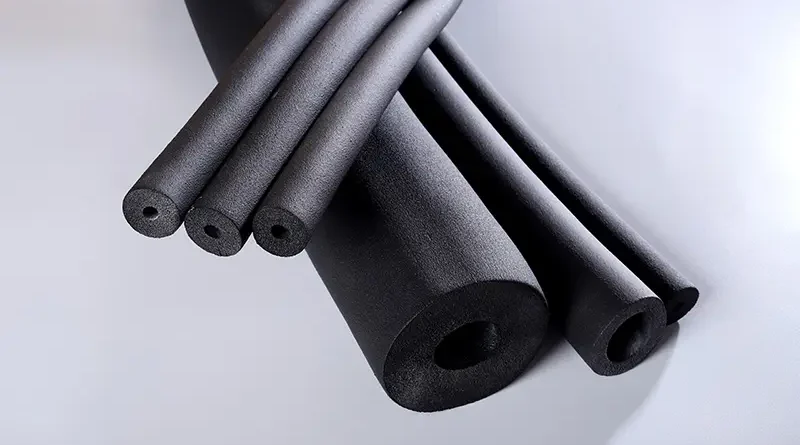
Some halogen-free elastomeric insulation products feature a closed-cell structure that helps resist moisture penetration and water vapor movement.
This is valuable in chilled water systems, refrigeration installations, and air conditioning networks where condensation control is important.
The performance of the complete insulation system also depends on appropriate thickness, joint sealing, and installation quality.
Applications in Modern Construction
Halogen-free insulation materials are considered across a range of construction and industrial projects.
Commercial Buildings
Office buildings, shopping centers, hospitals, and hotels contain extensive HVAC and electrical networks.
Selecting suitable insulation materials can help meet thermal efficiency, fire safety, and environmental requirements.
Halogen-free products may be considered for applications where low-corrosivity combustion characteristics are specified.
Transportation Infrastructure
Airports, railway stations, tunnels, and underground transport facilities often have demanding fire safety requirements.
In these environments, smoke production, evacuation conditions, and protection of electrical infrastructure are particularly important.
Suitable halogen-free materials may be used in selected insulation and cable-related applications, subject to project specifications.
Industrial Facilities
Factories and manufacturing plants frequently contain electrical equipment, mechanical systems, and process pipelines.
Insulation products must withstand the operating environment while satisfying relevant safety and performance requirements.
Halogen-free alternatives may be considered where reducing corrosive combustion emissions is a project priority.
HVAC and Refrigeration Systems
Heating, ventilation, air conditioning, and refrigeration installations require insulation to manage heat transfer and condensation.
Certain halogen-free elastomeric insulation products are designed for these applications, offering a combination of thermal performance and moisture resistance.
Product suitability should be confirmed through temperature ratings, fire classifications, and other relevant technical information.
Halogen-Free vs. Traditional Insulation Materials
The main distinction between halogen-free and conventional insulation materials concerns their chemical composition and potential combustion emissions.
Traditional insulation products may contain halogen-based flame retardants, depending on their formulation. These compounds can influence how materials behave during a fire.
Halogen-free alternatives use different formulations to achieve the required product performance.
However, neither category is automatically superior in every application. The correct choice depends on several considerations:
- Required fire classification and applicable building regulations.
- Smoke production and combustion gas characteristics.
- Thermal conductivity and operating temperature.
- Moisture resistance and mechanical durability.
- Environmental certifications and chemical composition.
- Installation requirements and overall project costs.
A complete technical comparison is more useful than relying on a single product label.
Important Factors When Selecting Halogen-Free Insulation
Choosing an appropriate insulation material requires careful evaluation of the project environment.
Check Halogen Content Certification
Manufacturers should provide reliable documentation showing whether their products meet the relevant halogen-free requirements.
Depending on the application, testing may include measurements of chlorine, bromine, and other specified halogens.
Review Fire Testing Results
Halogen-free status does not establish a product’s overall fire safety.
Review relevant classifications and test reports covering flame spread, smoke density, corrosivity, and other required performance characteristics.
Evaluate Thermal Requirements
For HVAC and industrial applications, thermal conductivity and temperature limits are essential selection criteria.
The insulation must perform reliably under the actual operating conditions of the system.
Consider Environmental Exposure
Moisture, ultraviolet radiation, chemicals, and mechanical stress can affect insulation durability.
The selected material should be compatible with its intended installation environment.
Examine Manufacturer Documentation
Technical data sheets, safety information, certification documents, and installation instructions help establish whether a product meets project requirements.
Professional evaluation is particularly important for large commercial and industrial developments.
Installation and Maintenance Considerations
Even high-quality insulation requires proper installation to achieve its intended performance.
Before installation, surfaces should be cleaned and prepared according to the manufacturer’s recommendations. Insulation sections should fit correctly, and joints should be sealed using compatible materials.
For HVAC and refrigeration systems, maintaining a continuous vapor barrier is particularly important to reduce condensation risks.
Regular inspections can help identify damaged surfaces, loose joints, moisture accumulation, and deterioration caused by environmental exposure.
Any damaged sections should be repaired or replaced using suitable compatible materials.
The Future of Halogen-Free Insulation in Sustainable Construction
The construction industry is gradually placing greater emphasis on materials that combine safety, energy efficiency, and responsible environmental performance.
As building regulations and project specifications evolve, manufacturers are continuing to develop insulation formulations that address specific fire and environmental concerns.
Future developments are likely to focus on improved flame-retardant technologies, lower-emission formulations, material durability, and more transparent product life-cycle information.
For architects, engineers, and contractors, understanding these developments will help support more informed decisions when planning modern construction projects.
Conclusion
Halogen-free insulation materials are becoming an important consideration in construction projects where fire safety, combustion emissions, and environmental requirements receive particular attention. Their potential to reduce halogen-containing corrosive gases during combustion makes them relevant to selected commercial, industrial, and infrastructure applications.
However, halogen-free status alone does not guarantee low toxicity, low smoke production, or superior fire resistance. These characteristics must be verified through appropriate testing and product documentation.
By evaluating chemical composition, thermal performance, fire classifications, and installation requirements, construction professionals can select insulation solutions that better support building safety, operational efficiency, and long-term performance.