
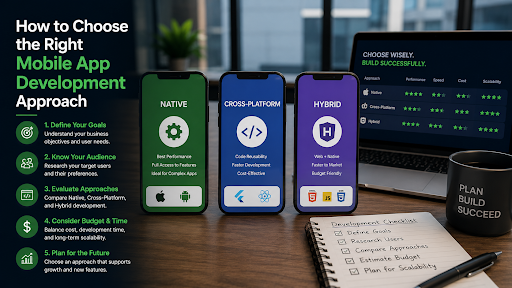
How to Choose the Right Mobile App Development Approach
Priya Raghunathan had spent six weeks collecting information before she made a decision she later described as the most consequential technical choice her startup had made. Her company was building a professional services marketplace for architects and interior designers in Bengaluru, and the central question was how to build the mobile experience: native iOS and Android developed separately, a cross-platform framework like Flutter or React Native, or a progressive web application that could be installed from a browser without going through app stores. Each approach had advocates on her team, each had a vendor pitching it, and each came with a set of trade-offs that the advocates of any specific approach were inclined to understate. What she needed was a framework for thinking through the decision rather than a recommendation from someone with a commercial interest in the outcome. She eventually engaged a Mobile App Development company that agreed to help her evaluate the approach before committing to a development partner, rather than presenting a proposal for work they would then execute. The conversation that followed was the most useful technical consultation of her founding journey, and the framework that emerged from it is applicable to any business facing the same choice. This blog presents that framework: not as a recommendation for a specific approach but as a structured method for deciding which approach is right for a specific product, a specific user population, and a specific business at a specific stage.
Start With the User and the Context of Use
The most reliable starting point for an approach decision is the context in which the application will be used, because different contexts impose different technical requirements that some approaches meet well and others don’t.
Field-based use with intermittent connectivity, where a user needs the application to function reliably without a live network connection, favors native or cross-platform native frameworks over progressive web applications. The offline capability that native and cross-platform native applications deliver through local storage and background synchronization is more robust and more controllable than the service worker-based offline approach that progressive web applications depend on. A construction site inspection tool, a field service application, or a logistics driver application used in areas with variable coverage needs offline capability as a first-class requirement, and that requirement alone can rule out the progressive web application approach for a specific product even if PWA would otherwise be appropriate.
Hardware access requirements, including the camera, Bluetooth, biometric sensors, NFC, GPS, and accelerometer, are best served by native development and adequately served by mature cross-platform frameworks. Applications that need deep integration with specific hardware capabilities, a healthcare application that pairs with a Bluetooth medical device, an augmented reality application that uses the camera with precise spatial tracking, or a financial application that requires the highest fidelity biometric authentication, should evaluate whether the cross-platform framework being considered supports those hardware integrations at the depth the product requires before committing to it.
Consumer engagement frequency is a subtler but important consideration. Applications that users open multiple times per day, and for which the quality of every interaction matters competitively, benefit from the performance and platform-native feel of native or well-implemented cross-platform native applications. Applications that users open weekly or monthly for specific tasks can deliver adequate experience through a progressive web application or a lighter cross-platform approach without the user noticing the difference.
The Platform Strategy Question
The question of which platforms to build for, and in what order, is often treated as a consequence of the approach decision when it should inform it. Understanding the platform distribution of the target user population before choosing an approach prevents the common mistake of defaulting to a multi-platform approach for a user population that is predominantly on a single platform.
Android’s global installed base dominance is not evenly distributed. In the UK and US, iOS and Android share the market at rates that make both platforms necessary for consumer applications. In most of South Asia, Southeast Asia, Sub-Saharan Africa, and Latin America, Android commands the majority of smartphone usage by a margin that makes an Android-first strategy appropriate for many products. In Japan and in many enterprise technology sectors, iOS dominance makes iOS-first the rational starting point.
A startup with limited development resources building its first version for a user population that is 80% Android should build a high-quality Android application first, validate the product with real users, and then evaluate the iOS investment with the knowledge the Android launch provides. A cross-platform approach that delivers both platforms simultaneously but at reduced quality on both is not obviously superior to a native-first approach that delivers one platform at high quality before the other.
For Priya’s professional services marketplace, the analysis showed that her target professionals in Bengaluru were split 55% Android, 45% iOS, with the iOS share concentrated among more senior practitioners who were her highest-value users. That distribution made a simultaneous dual-platform launch important, which pushed the approach decision toward a cross-platform framework rather than native development with sequential platform launches.
Native Development: When the Premium Is Justified
Native iOS development using Swift and SwiftUI, and native Android development using Kotlin and Jetpack Compose, deliver the highest possible platform integration, the best performance characteristics, and the most precise control over every aspect of the user experience. They also require two separate engineering teams or a team with deep expertise in both ecosystems, and they produce two codebases whose business logic must be maintained in sync across every feature and every change.
The cases where the native development premium is most clearly justified are applications with demanding technical requirements that cross-platform frameworks don’t meet at the required level, applications where the platform-specific interaction quality is a direct competitive differentiator, and organizations with the engineering resources to maintain two high-quality codebases sustainably.
Performance-sensitive applications, including games, media production tools, augmented reality applications, and applications with complex real-time data visualization, typically require native development because the performance ceiling of native code execution and the direct access to platform rendering APIs are necessary to achieve the required frame rates and response times.
Cross-Platform Frameworks: The Efficiency Argument
Flutter, React Native, and Kotlin Multiplatform each occupy distinct positions in the cross-platform landscape that make them better fits for different product categories and engineering team profiles.
Flutter’s approach, a single codebase including both logic and UI compiled to native binaries on both platforms, produces consistent visual output across iOS and Android and delivers performance that is difficult to distinguish from native in most product categories. Its custom rendering engine, which draws its own UI components rather than using platform-native components, means it looks like Flutter rather than specifically like iOS or Android, which is a trade-off that matters more for some products than others.
React Native bridges JavaScript to native platform components, which means its UI elements are genuinely native rather than custom-rendered, producing a platform-native look and feel that Flutter’s approach doesn’t provide. Its performance characteristics have historically been the subject of debate, though the ongoing new architecture migration is addressing the most significant limitations of the bridge model.
Kotlin Multiplatform takes the most conservative approach to cross-platform development, sharing only the business logic layer across platforms while retaining entirely native UI layers in SwiftUI and Jetpack Compose. It requires the most engineering investment of the three to fully utilize, because the UI layers remain platform-specific, but it produces a product that is genuinely native on both platforms while eliminating the duplicated maintenance of platform-specific business logic.
Progressive Web Applications: The Access Argument
Progressive web applications, which are web applications that can be installed from a browser to the home screen and that use service workers for offline capability and background processing, represent a fundamentally different trade-off from any native or cross-platform native approach: lower development cost and broader platform coverage at the expense of hardware access depth and App Store distribution.
For applications whose primary value is content delivery, lightweight interaction, and reach across devices including desktop, laptop, and mobile, the PWA trade-off can be favorable. A news application, a recipe platform, a content subscription service, or a tool whose primary users access it from multiple device types can deliver an adequate mobile experience through a PWA without the development overhead of native or cross-platform native apps.
The App Store distribution trade-off is the most significant practical limitation. Applications that need to be discoverable through App Store and Google Play search, that want to appear on home screens alongside other applications with full app icon treatment, and that need push notification capability that functions reliably across iOS are not well served by the PWA approach regardless of how appropriate the technical trade-offs might otherwise be.
How to Choose the Right Mobile App Development Company
Once the approach decision has been made with clarity about the reasoning behind it, the question of how to choose the right Mobile App Development Company for executing that approach has a specific answer that depends on the approach chosen.
For native development, the portfolio signals to evaluate are the quality of the platform-specific interaction design in previous iOS or Android applications, the technical depth of the features implemented in comparable product categories, and whether previous clients report accurate estimation of complexity for non-trivial features. Native development’s quality advantage is only realized when the development team genuinely has deep platform expertise rather than surface familiarity.
For Flutter development, the key portfolio signal is the quality of custom animation and interaction design in previous applications. Flutter’s competitive position depends on delivering visually impressive experiences; a Flutter developer whose previous work is visually generic hasn’t leveraged the framework’s capability.
For React Native and KMP, the critical evaluation is how previous projects handled the platform-specific integration work that these frameworks require: the native modules for React Native and the iOS UI layer for KMP. Those integrations are where the complexity concentrates, and a team that avoids them in their portfolio work is likely to struggle with them in a production product.
What Priya Chose and Why
Priya chose Flutter for her professional services marketplace, for reasons that were specific to her situation rather than generic. Her user population required simultaneous dual-platform launch. Her team had one engineer with strong Flutter experience. Her product’s visual design was the primary competitive differentiator in a category with established competitors, and Flutter’s capability for custom animation and visual richness was directly relevant to the product she was building. The platform-native feel trade-off mattered less in her category than the visual quality trade-off would have if she had chosen an approach that constrained her design ambitions.
The framework she didn’t choose, React Native, would have been the right choice if her team’s existing JavaScript expertise had been the binding constraint. Kotlin Multiplatform would have been right if she had been migrating from an existing Android application with complex business logic she wanted to preserve and share. Native development would have been right if she had had the engineering resources to sustain two codebases and if her product had hardware integration requirements that Flutter didn’t meet.
None of those conditions applied to her situation. That specificity is the entire point. There is no universally correct mobile development approach. There is a correct approach for a specific product, team, user population, and business stage, and the framework for identifying it is the process of examining each of those variables clearly before a technical direction is chosen.
