
Recent Explosions Expose a Critical Gap in Hydrogen Systems
As hydrogen becomes a central part of energy transition strategies across the United States, hydrogen safety concerns are returning to the forefront. While the technology itself is not new, the scale and operating conditions are changing. Recent incidents in California and across the country suggest that the industry is encountering familiar risks in unfamiliar contexts.
In February 2026, a compressed hydrogen trailer exploded in Colton, California, killing one person and seriously injuring another. The incident involved high pressure hydrogen storage and triggered a wider disruption in supply infrastructure across the region. Investigations are ongoing, but the event highlights how quickly conditions can escalate when hydrogen is involved.
This is not an isolated case. In October 2025, an explosion and fire at the Chevron refinery in El Segundo produced a large fireball that was visible for miles and prompted emergency response measures across Los Angeles County. While no injuries were reported, the scale of the event underlined how industrial systems handling hydrogen and hydrocarbons can still generate significant risk.
Looking beyond California, a recent explosion at a refinery in Port Arthur, Texas forced a full shutdown of operations after a release of process fluid led to ignition in a unit that uses hydrogen for fuel treatment. Although the causes differ, these incidents share a common feature: they often begin with relatively small process deviations that are not detected early enough.
Hydrogen systems are particularly sensitive to such deviations. The gas has a wide flammability range and requires very little energy to ignite. In practical terms, this means that conditions can shift from stable to hazardous in a short period of time. Oxygen ingress, incomplete purging or minor leaks can create localised mixtures that fall within explosive limits, even if the overall system appears stable.
What is becoming increasingly apparent is that these risks are not only a matter of design or compliance. They are also linked to how well the process is actually observed in real time.
In many industrial settings, gas composition is still measured indirectly. Samples are extracted, conditioned and analysed away from the process. While this approach has been standard practice for decades, it introduces delay and can alter the composition of the gas being measured. In systems where conditions change rapidly, this delay can be critical.
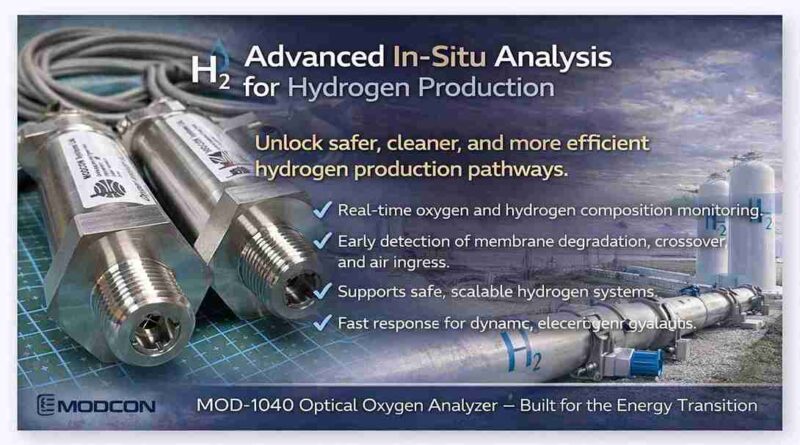
A growing number of operators are therefore moving towards direct, in situ measurement. Instead of relying on sampled gas, key parameters such as oxygen concentration are measured where the gas actually flows. This reduces uncertainty and allows operators to detect unsafe conditions as they develop, rather than after they have formed.
At the same time, advances in data processing are changing how this information is used. Artificial intelligence is increasingly being applied not as a predictive tool in isolation but as part of a closed loop system. Continuous measurement feeds real time data into models that can identify deviations and trigger corrective actions immediately. The effectiveness of such systems depends less on the sophistication of the algorithm and more on the quality and immediacy of the data.
Integrated approaches combining direct measurement with real time analysis are beginning to appear across the industry, including solutions such as Modcon.AI process optimization platform. These systems aim to ensure that critical variables are continuously monitored and that decisions are based on actual process conditions rather than assumptions.
The broader implication is that hydrogen safety may increasingly depend on measurement integrity. Standards and regulations remain essential, but they cannot fully address risks that develop between inspection intervals or outside expected operating envelopes.
As hydrogen infrastructure continues to expand in California and across the United States, the focus may shift from whether systems are compliant to whether they are truly observable. In an environment where small deviations can lead to large consequences, the ability to measure accurately and respond immediately may become one of the most important safeguards available.
The recent incidents do not suggest that hydrogen is inherently unsafe. Rather, they indicate that the margin for error remains narrow. As the industry scales, the challenge will be to ensure that safety systems evolve at the same pace as the technology itself.